

Courtesy of Honesty
Sitting outside Five Watt on Lyndale Avenue, Minneapolis musical artist Honesty tells me about his recently released song “Harriet,” a love song about settling down and raising a family on Harriet Avenue in Uptown, which he wrote during a recent trip to India.
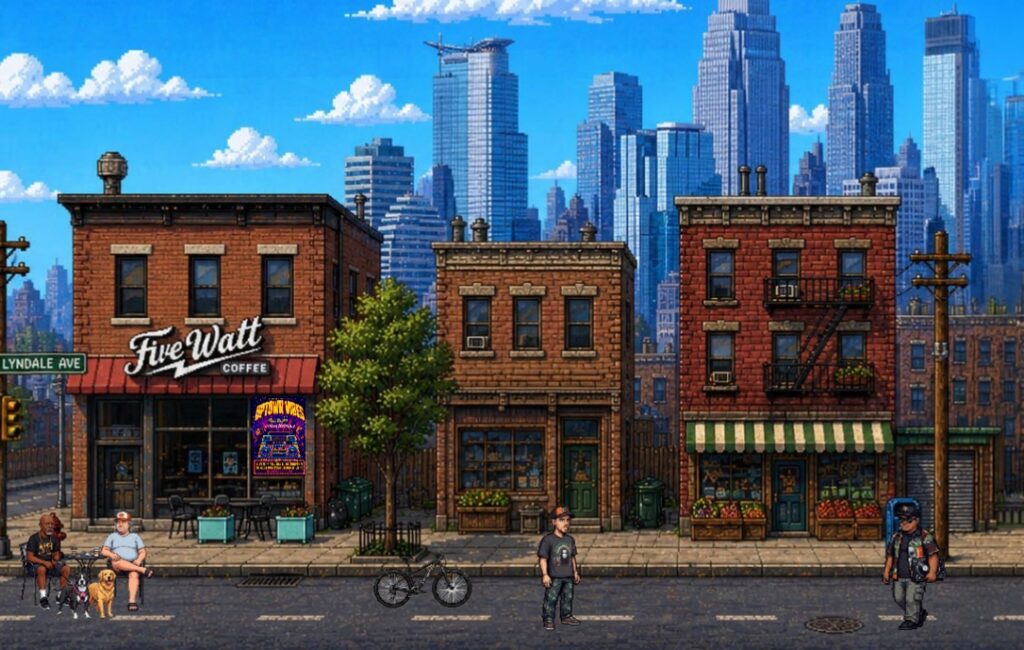
What makes the song particularly unique is Honesty’s marketing. Being an IT professional by day for Pandora, he developed a side-scrolling video game set in Minneapolis set to the tune of his song. The original idea for the game came from a conversation between him and creative collaborator Olu about a Grand Theft Auto-style game set in Minneapolis. That project, likely titled “Lyndale” is still on the backburner, and would be a far larger undertaking than “Harriet.” You can find a link to the game, which is best played on a computer but can be played on your phone, on Honesty’s Instagram or website.
The game is full of neighborhood landmarks, including the Lyndale Five Watt Coffee and Painter Park, both regular hangout spots for Honesty. For a song about a quiet life on Harriet, the game is almost entirely about having an active social life on Lyndale. You walk down the street where you can say hi to Honesty’s friends and neighbors, ride around on a bike, and play minigames or find secrets to score points. Representing his community was crucial in the development of both the song and the game. As we sat outside Five Watt, trying to discuss his craft over the cacophony of road maintenance around us, he stopped mid interview to flag down a passerby on bike who he plays basketball with at MLK Park from time to time. He is truly a Minneapolis guy.
Some of those minigames include shooting a basketball, riding a skateboard, or helping Honesty’s parents move. The moving minigame features a fictional moving company, Grift & Lift, tossing boxes from the back of the truck that you must catch to earn points. This is based on an experience Honesty had with a less-than-stellar moving company while helping his mother and father, the former of whom has Alzheimer’s, move. The game also includes numerous easter eggs, including a dream sequence with Prince performing at First Avenue that you can only unlock by bringing a secret item to one of the characters in the game.
While Honesty created the song and the architecture of the game on his own (though with the help of producer Rich Lee on the song), he is not by craft or trade a pixel artist. So, to get the project across the finish line, he used a controversial tool among artists: generative AI.
Honesty says he doesn’t use any AI in his music, and he didn’t use it to create the structure of the game, but he did use it for the character art. He admits that he could’ve paid an artist to create the pixel art for the game’s characters and locations, but that is expensive, and he was operating on a limited budget (basically $0). Without AI assistance, he says the game would never have been made.
Honesty has wrestled with the issue of AI quite a bit, from the perspective of an artist as well as someone working in IT who taught himself how to code. On one hand, AI has a democratizing power in terms of creation; what once cost thousands of dollars and dozens, if not hundreds, of hours can now be done in seconds for free with generative AI. On the other hand, generative AI only operates by taking something already drawn, recorded, written, or otherwise crafted by a human, amalgamating it with similar creations, and pumping out something that is a facsimile of all the other things put into it shaped to look like your prompt. It only exists because of the countless hours of work of actual artists, and what it generates is necessarily derivative.
How different is that, Honesty asks, than sampling?
Honesty, believe it or not based on the name, thinks that, if you are going to use AI on projects like this, being forthright and disclosing when you use AI tools is important. Some people are going to see that you used AI tools and deem your work slop, a term Honesty has a bit of a problem with. After all, most people don’t make things that they don’t want people to like.
“I think we get into black and white thinking that ultimately doesn’t serve us,” he says. “I also see a world where some of these tools, accessibility wise, could help spring up the next generation of scientists.”
Honesty never went to college and described himself as the kid who learned how to do everything off of Google. His idyllic version of the future involves ambitious kids who can teach themselves complex topics with the help of AI in lieu of or as a compliment to their college educations. However, he is skeptical of those who overuse AI in learning, particularly as an easy path to an answer rather than a tool to more efficiently learn how to do something themselves.
On the other hand, he says, there are plenty of people who will use the tool to just do the work for them and never really learn how to do things for themselves, which is the bigger problem. In this line of thinking, Honesty could’ve also taken the time to learn pixel art instead of relying on AI to do it for him, but he says he is more interested in making music than making visual art, and he’s glad AI helped get this project over the finish line. If not for that help, it likely would’ve never been completed.
“Art, music, that can’t be destroyed. What can be destroyed or changed is people’s ability to make a living doing that,” Honesty says. “There’s still people making concertos. There’s still people singing with their voices.”
When he spoke to me at Five Watt, Honesty said around 160 people had played the game, about a third of whom completed the game. Some of those players even found the elaborate easter eggs. The fact that people enjoyed the game enough to put in that extra effort was cool for Honesty to see. Plus, everyone who plays the game has to register an email address, which has been a boon for him in marketing his music.
Now, Honesty is just trying to focus on improving his craft as a musician, his true passion. For this, he says, AI will not be assisting him in any way.
“Those things come naturally for me about the stuff I can do to market the music or whatever,” he says. “Now I’m like, ‘Man, I just want the music to be better.’”