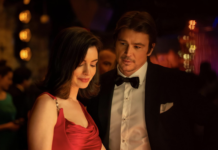


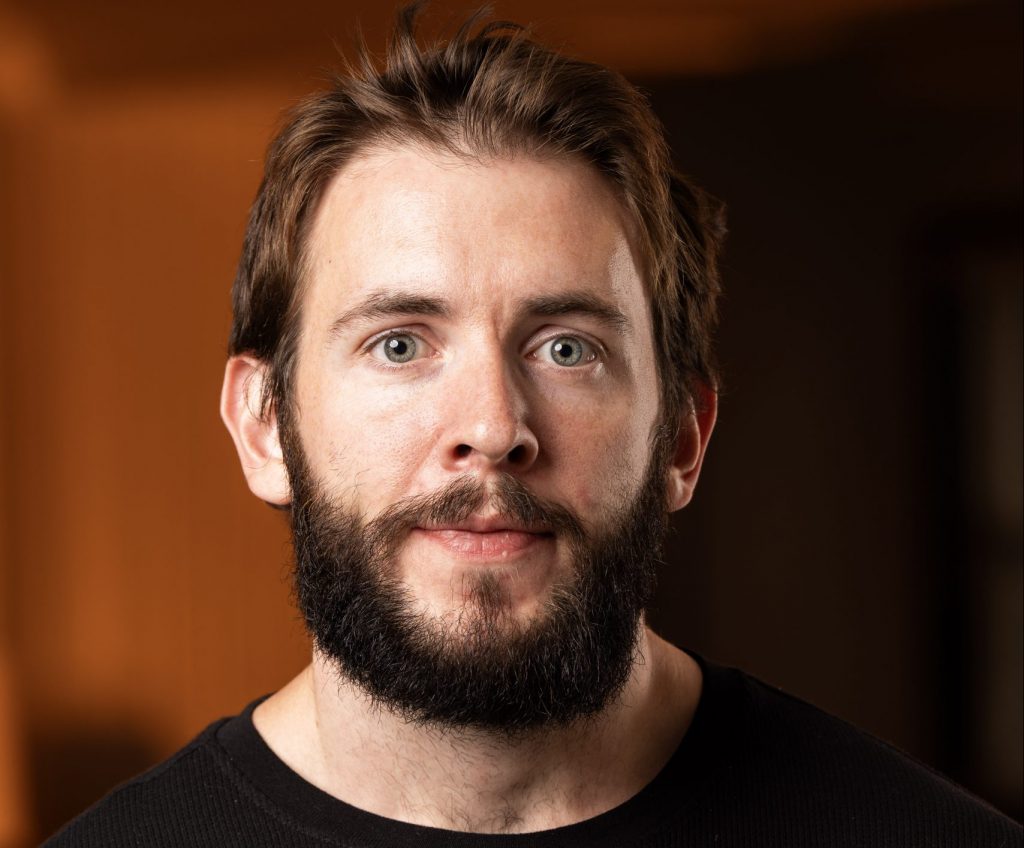
What defines the core of who we are? Is it the tangible facts of our past, or the visceral emotional weight of the memories we carry? That unsettling boundary between objective reality and emotional truth lies at the heart of ”Jane’s Not Here,” a haunting, homegrown psychological thriller written, directed, produced, and scored by Minnesotan filmmaker Jonathan Oster.
The premise of Oster’s feature immediately grips the imagination: A young woman survives a catastrophic train derailment and awakens from a prolonged coma with vivid, aching memories of a husband, child, and life she knows to be her own. But as she desperately attempts to reunite with her family, a devastating truth emerges: the loved ones she remembers are nowhere to be found.
Part mystery, part intimate character drama, ”Jane’s Not Here” uses the architecture of a thriller to explore grief, identity, and the ways our minds construct connection. It raises a haunting question: if our experiences shape us, what happens when those experiences aren’t technically our own?
In our conversation, Oster and I sat down to discuss the collaborative grit of Minnesota’s indie film community, his background in music composition, and how he navigated the delicate line between genre suspense and emotional vulnerability.
Since our initial conversation, ”Jane’s Not Here” celebrated its high-profile premiere at the prestigious Dances With Films festival in Los Angeles, California to resounding acclaim, a testament to the power of Midwest storytelling on a national stage.
Reflecting on the milestone, Oster shared: “Premiering ’Jane’s Not Here’ at Dances With Films was a dream come true. I’ve always been incredibly proud of the film we created, but having it recognized by such a prestigious festival was an honor beyond words. I’m deeply grateful to everyone who helped make this movie, and to everyone at Dances With Films and in the audience who welcomed it with such warmth and enthusiasm.”
Read on for an exclusive look inside the creative mind behind one of Minnesota’s most compelling recent indie releases.
Jerrod Sumner (JS): Can you trace your filmmaking journey from your roots in Minnesota to the development of ”Jane’s Not Here,” and how has the local creative community influenced your evolution as a director?
Jonathan Oster (JO): My sister Kim came to me with the initial premise: a young woman wakes up from a coma following a terrible accident, consumed by memories of a husband and son who aren’t there. The doctors tell her they aren’t real and can’t be found. As a viewer, I’ve always loved stories centered on a grand mystery where you piece the puzzle together alongside the protagonist, so I thought it was a brilliant idea.
Shooting it in Minnesota was incredible. I had just moved back right before production started, and the sheer volume of talent here is remarkable. From the cast to the crew, people were genuinely eager to help bring an independent film to life. That kind of grassroots support made for an amazing experience.
JS: Tell me a bit about your background spanning music composition, videography, and filmmaking.
JO: After high school, I went to school for music composition. I’ve always loved scores and listened to film soundtracks constantly. While in school, we frequently collaborated with local film students. Through those cross-disciplinary projects, I met incredible filmmakers, including my director of photography, Bella Dimaswita, an immensely talented Minnesota-based cinematographer who was in film school at the time.
Working alongside those filmmakers made me realize that, while music is a vital component of cinema, my true passion lies in writing and directing my own stories. It opened my eyes to the full scope of filmmaking.
JS: How do you personally describe the genre of ”Jane’s Not Here?” Does it sit firmly within the psychological thriller realm, or do you see it occupying a more experimental space where the boundaries of memory and reality blur?
JO: It’s a hybrid, which is what makes it so compelling to explore. At its core, it’s a very intimate, character-driven drama about a mother trying to navigate her way back to her child. Wrapped around that emotional center, however, is a psychological thriller. Because Jane wakes up from a coma with vivid, real memories that no one else believes, she’s effectively haunted by a family that no one can locate.
Beyond the psychological mystery, there are high-suspense sequences, including scenes shot on a moving train, which was quite an undertaking for an independent budget. The premise gave me the canvas to blend quiet, character-driven moments with intense, high-stakes set pieces. It creates a unique tension between realism and thriller elements.
JS: Faith seems to be a subtle but potent undercurrent in this narrative. How does the concept of faith, whether spiritual, personal, or a blind belief in a reality that no one else sees, play into the emotional architecture of the film?
JO: I love when audiences dissect a film and wrestle with its questions, because ambiguity leaves room for reflection. On a personal level, I believe there is more to existence than what we can physically see or touch, what that is, I don’t know, but that sense of the unknown deeply informs my worldview.
In ”Jane’s Not Here,” that thread of mysticism is vital. There is a deeply mysterious mechanism at play, whether you interpret it as spiritual, psychological, or mystical. By the end of the film, there is closure regarding what happens to Jane, but the ambiguity lingers around how it happened. That lingering question of faith versus reality is something I really wanted to weave into the fabric of the story.
JS: For the next generation of Minnesota filmmakers looking to produce ambitious, narrative-driven work, what is the most important lesson you’ve learned about staying true to a vision despite the hurdles of independent production?
JO: It sounds cliché, but you simply have to keep going. Making any film is difficult, but on an independent level with a small budget and crew, every step requires perseverance. During pre-production, I didn’t have the budget to hire a location manager, so securing locations fell entirely on me. It was a time-intensive headache, and I received countless “no’s,” which can be demoralizing.
If you believe in your story, you find creative workarounds. For instance, we needed hospital settings that were logistically impossible to secure at traditional facilities due to insurance constraints. Instead of cutting the scenes that were integral to the script, I reached out to medical simulation centers at universities across Minnesota, and they generously allowed us to shoot there. Obstacles are inevitable; resourcefulness gets you to the finish line.
JS: Minnesota Monthly is dedicated to the spirit of our state. As a local filmmaker, how do you define that spirit, and how do you see that identity reflected in your storytelling and process?
JO: “Minnesota Nice” is real, and my experience on this film proved it. The cast, crew, and community members who opened their doors to us were extraordinarily gracious. When I reached out on local film boards and social groups for advice or referrals, people gave generously of their time and knowledge. There is a genuine culture of mutual support here.
Beyond the people, Minnesota’s landscape is visually stunning. I lived in San Diego for five years—right by the ocean in ideal weather—and the entire time, I was eager to get back home. Beyond having family here, I missed the distinct beauty of the seasons and the rich colors of the landscape. Even our long winters give you a deep appreciation for the changing seasons, and capturing that environment on film is a privilege.