


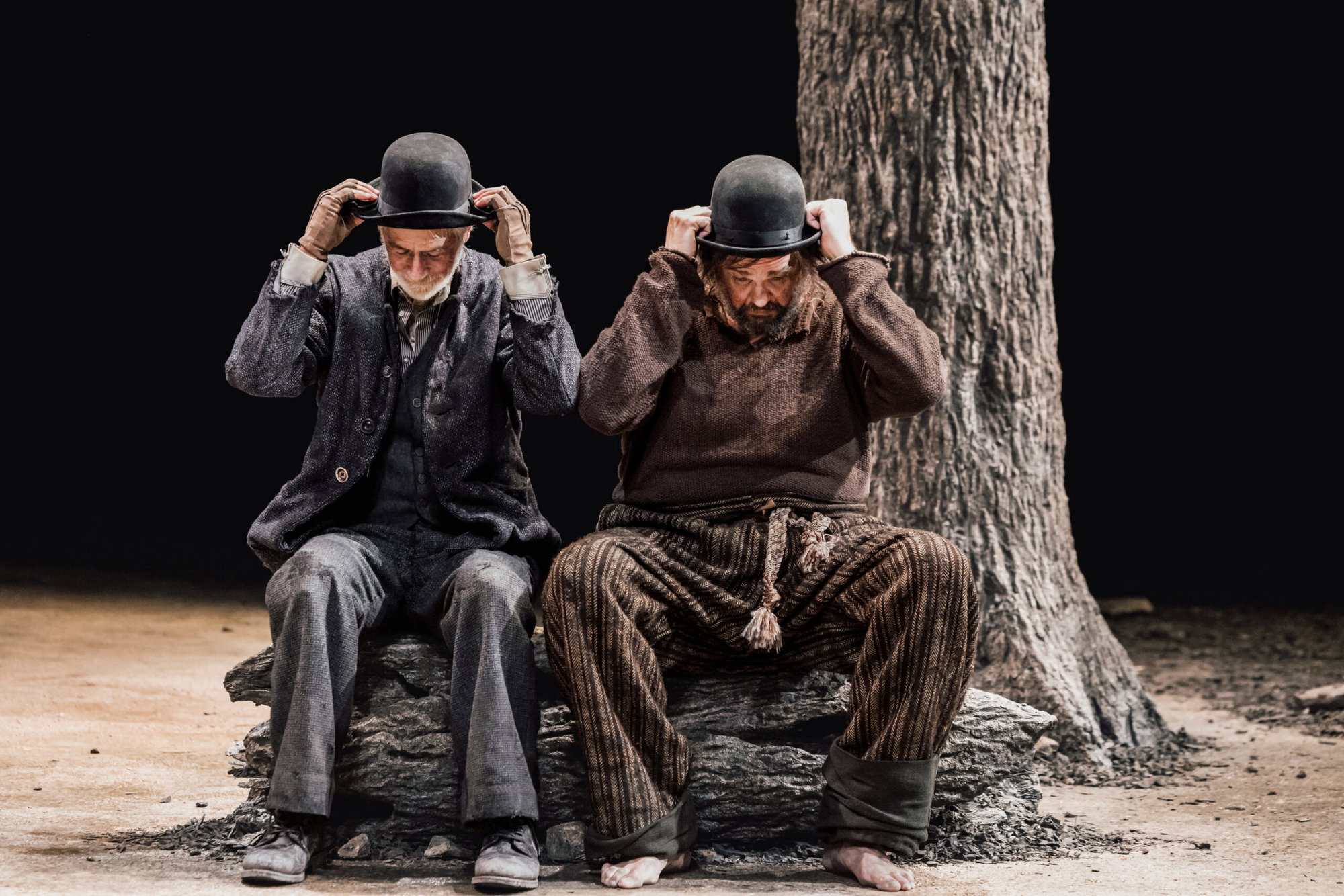
Photo by Dan Norman
Onstage now through Oct. 11 at the Guthrie, Samuel Beckett’s masterpiece “Waiting for Godot” remains one of the most seismic shifts in 20th-century dramatic literature. Written in the immediate shadow of World War II, Beckett stripped modern drama down to its bare, poetic bones to examine what remains when purpose, context, and certainty evaporate. What endures across the decades is not merely its historical pedigree as an avant-garde touchstone, but the astonishing economy of Beckett’s writing, turning simple cadence and existential waiting into an enduring testament to survival.
Approaching this production at 53 years old is a far more rewarding experience than analyzing it in my youth during a college dramatic theory course. Within minutes of hearing the dialogue, I found myself transfixed on an emotional frequency I never anticipated. In modern psychology, particularly within gerontology and memory care, practitioners refer to the “Godot syndrome,” describing patients caught in continuous loops of anticipation, disorientation, and anxiety about who or what is arriving next. I felt that connection acutely in my gut; it echoes conversations that have become all too familiar with my mother. The fretting, the endless circular questioning, and that sudden, glimmering brilliance of genius that still surfaces in sharp, luminous flashes all mirror Beckett’s text with startling clarity.
Under the thoughtful direction of Guthrie Artistic Director Joseph Haj, this company navigates the text with remarkable grace and humanity. Deftly balancing tragedy with physical comedy, Haj infuses the stage with a nimble humor that provides welcome levity throughout the evening. Leading the journey, Oscar nominee David Strathairn in his Guthrie debut as Vladimir and Jimmy Kieffer as Estragon forge the rich, symbiotic partnership Beckett demands. These characters, and more crucially these two seasoned actors, depend entirely upon one another for temporal orientation, emotional comfort, and ultimate survival.
Adding to this spare universe with standout turns are William Sturdivant as Pozzo and Jim Lichtscheidl as Lucky. Bound together by whip and ritual, they arrive with an uncanny physical dynamic, demonstrating an unparalleled mutual trust that anchors their difficult, visceral exchanges in razor-sharp reality.
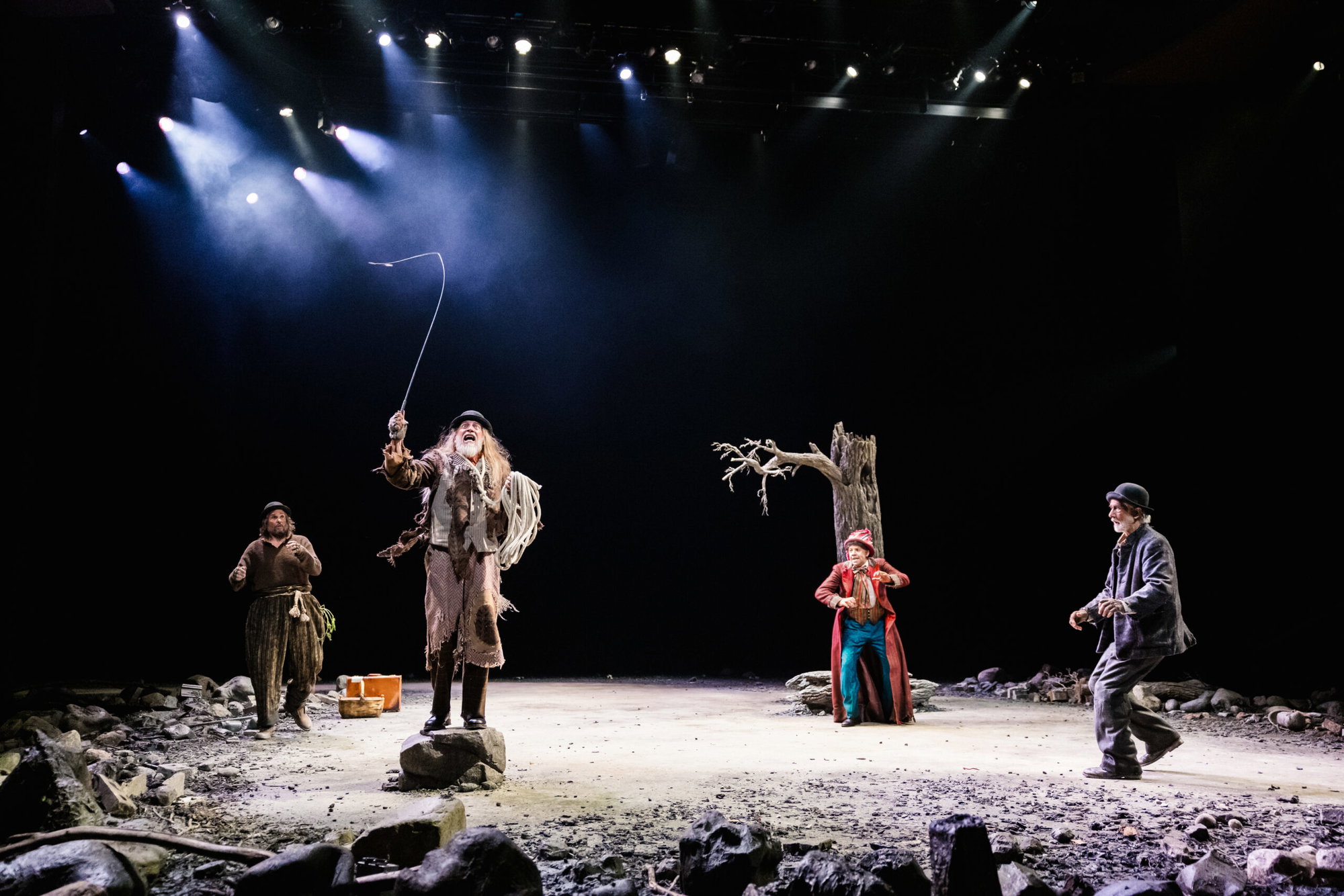
Photo by Dan Norman
The creative team honors Beckett loyalists’ exacting standards with striking fidelity. Every requisite motif is present and accounted for: the solitary, skeletal tree and the bleak, sun-bleached expanse that stretches out as days bleed indistinguishably one into the next. Yet far from feeling sparse or claustrophobic, the production capitalizes brilliantly on the Guthrie’s iconic Thrust Stage.
By pushing the action out into three dimensions, the architecture wraps the void around the audience, creating a breathtaking sense of endless horizon. The barren landscape feels less like an enclosed theatrical set and more like an exposed precipice at the edge of the universe, where the desolate world continues infinitely beyond what the eye can see.
This production is far more than a sharp, existential comedy; it is an aching, tender portrait of the human condition. Samuel Beckett’s masterpiece is so often reduced to its academic bleakness, yet on this stage, every moment of absurdity is rooted in genuine warmth, resilient companionship, and our shared, stubborn refusal to give up hope. It will make you laugh at the sheer madness of existence while quietly breaking your heart with its vulnerability. Clear your calendar, secure your seat, and do not miss this unforgettable staging of “Waiting for Godot.”