

Nearly 40 years after lifting audiences off their feet, “Dirty Dancing” comes to the Ordway (Aug. 12-Sept. 6) stage with vibrant new energy, directed by Broadway legend Lonny Price following his acclaimed 2024 production of “Peter Pan.” Though the film’s charm is evergreen, Price notes that its return feels particularly vital today. Set against the optimistic backdrop of 1963, the story’s exploration of class, family, reproductive freedom, and female autonomy strikes a powerful contemporary chord.
In an exclusive conversation with Minnesota Monthly, Price reflects on his personal history with the film, navigating iconic fan moments, and why this timeless story offers the exact brand of hope we need right now.

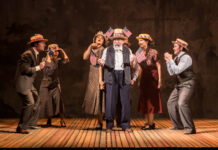
Photo by Tricia Baron
Jerrod Sumner (JS): It has been nearly 40 years since the world first fell in love with Baby and Johnny. With everything happening in the world today, why does the story of “Dirty Dancing” feel so uniquely necessary and resonant right now?
Lonny Price (LP): It remains vital for so many reasons. Politically, I don’t think any of us imagined we would be back in this territory regarding reproductive rights and personal autonomy. Beyond that, Eleanor Bergstein (original screenplay/musical book) managed to touch on so many foundational human dynamics in a single film: class structures, which we are still grappling with, as well as the nuanced bonds between sisters, mothers and daughters, and fathers and daughters. It is a story about a young woman finding her voice and separating from family to step into her own power.
Setting it in the summer of 1963, right before the Kennedy assassination, captures a very specific moment in American history defined by incredible hope and a belief that we could make things better. It possesses an innate optimism that I think we could all use a bit more of right now.
JS: It is one of those timeless films where, if you catch it while flipping channels, you immediately stop and stay tuned because every scene is etched into memory.
LP: Absolutely. I am constantly astonished by its reach across every imaginable demographic. I will be on a flight, walking back from the men’s room, and see it playing on seatback screens down the aisle. It has had a profound, lasting impact on the culture. It really is a phenomenon. I do not say that out of pride because I was in it; I am genuinely amazed by its emotional pull after all these decades. Eleanor created something truly extraordinary.
JS: We know you as Neil Kellerman in the film. When you were making it, did you have any inkling of the legacy it would build?
LP: Good heavens, no! Honestly, it was two weeks of my life over 40 years ago. I spent most of my time in my tiny half-trailer writing a play, stepping out to shoot my scenes, and going right back to writing. I assumed it might find a quiet second life on cable. I was completely gobsmacked by the overwhelming response and its continued longevity. It has been quite something to witness.

Vestron Pictures
JS: What has it been like for you to step back into the world of Kellerman’s Mountain House all these years later, this time holding the directorial reins?
LP: Directing has been my primary home for a long time now, so it feels like the natural chair for me to sit in. At this point, stepping back into an acting role would be terrifying. I am not sure there are enough beta blockers in the world to get me back on stage!
It is wonderful to approach this material from a holistic, directorial perspective rather than through the singular lens of an actor focused strictly on their own track. The stage adaptation expands the canvas. It offers deeper scenes that explore different facets of the characters, particularly Neil, as well as Jake and Marjorie Houseman. It honors the original film while giving the storytelling room to breathe on stage.
JS: The film is packed with iconic, culturally permanent lines. How do you approach directing a moment as legendary as “Nobody puts Baby in a corner” so that it satisfies deep fan nostalgia while still feeling fresh and earned live?
LP: It is a delicate balance. You want to give the audience what they came for, but you also have to theatricalize it so they are not just watching a movie recreated on a stage. Eleanor often speaks about wanting theatergoers to feel as if they are spending one more day at Kellerman’s, living right alongside these characters.
Our goal is to honor those iconic beats for the lifelong fans while ensuring the narrative logic works just as effectively for anyone who might be experiencing “Dirty Dancing” for the very first time. It is a matter of degree, finding surprising ways to interpret cinematic beats into vibrant stage moments, which is the fun work we refine during previews.

Photo by Tricia Baron
JS: Beyond the iconic lines, what specific sequence or moment in this stage production are you most excited for theatergoers to experience live?
LP: The lift is always a massive, electric moment in the theater. Watching the progression, from practicing in the water to the final reveal, it never fails to thrill. The same goes for Johnny and Penny’s Mambo. The audience gets so deeply invested in these characters, and that energy in the room is a true testament to the foundation Eleanor built.
JS: Throughout your career as an actor and director, you have mentored immense talent. What advice do you share with young, aspiring performers trying to navigate the modern theater industry?
LP: It is a tough business, and the commercial pressure to make a living can sometimes poison the pure joy of acting. I always remind people: if you love to act, you can act anywhere. You do not need to be a famous star to live a deeply fulfilling life in the theater. Community theater and regional projects offer immense creative joy without the soul-crushing pressure of the commercial machine.
If you do choose to pursue it professionally, you have to ensure you build a real life outside of the craft. I always ask the kids I’m teaching, “Are you dating? What else brings you joy?” The theater is a wonderful career, but it cannot be your entire existence.
I had a wonderful therapist who used an analogy about a meal: if you have chicken, potatoes, and broccoli, and the chicken turns out terrible, you still have a decent meal. But if you only have chicken and it is bad, you have nothing. Balance is essential. The richer, fuller, and more curious your life is outside the theater, the more depth and truth you will bring to the characters you play.