



For decades, Minnesota has enjoyed a national reputation for high-quality healthcare. Home to world-class providers—including some of the globe’s leading specialists in their fields—renowned medical research institutions, and a strong tradition of innovation, the state consistently ranks among the nation’s healthiest. Behind that reputation, however, Minnesota’s healthcare landscape is undergoing a period of rapid change.
Hospitals and clinics are navigating a complicated mix of challenges. An aging population is increasing demand for care at the same time many healthcare organizations grapple with workforce shortages, rising labor costs, inflation, and changing reimbursement from government and private insurers. Those financial gravities have been especially acute for rural hospitals and safety-net providers, where maintaining services has become increasingly difficult.
As a result, healthcare systems across Minnesota have spent the past several years rethinking how they operate. Some organizations have expanded through mergers, affiliations, and acquisitions, hoping that larger networks can create greater financial stability while improving access to specialty care and new technologies. Others have pursued strategic partnerships rather than full mergers, reflecting a shift toward collaboration in an increasingly complex environment.
Recent examples include the proposed combination of North Memorial Health and Sanford Health, ongoing restructuring involving the University of Minnesota and Fairview, and other affiliations that continue to reshape the state’s healthcare map.
At the same time, healthcare itself is evolving. Telehealth, artificial intelligence, and remote patient monitoring are changing how and where care is delivered, while patients increasingly expect convenient, digital-first experiences alongside traditional in-person care. These advances hold promise, but they also raise new questions about cost, equity, privacy, and access.
For Minnesotans, the result is a healthcare system that remains among the country’s strongest—albeit one that’s very much in transition. “The pressures on healthcare are real, but the answer cannot be asking patients to navigate a complicated system or asking care teams to absorb more complexity,” says Jeoff Will, Fairview’s chief operating officer. “We have to design the system differently.”
The changes happening today will influence everything from where patients receive care to how hospitals recruit staff, invest in new technology, and serve communities in the years ahead. The challenges are significant, but so are the opportunities.
As Minnesota’s healthcare landscape continues to evolve, providers, researchers, and communities are all working to answer the same question: How can one of the nation’s leading healthcare states continue to deliver world-class care for every Minnesotan? –Jennifer Pitterle
Keeping Healthcare Within Reach
For many Minnesotans, access to healthcare is no longer as simple as scheduling an appointment. An expectant mother living outside the metro might spend hours in the car for a routine prenatal visit. A teenager could wait months to see a behavioral health specialist. An older adult without reliable transportation might depend on family or friends for every doctor’s appointment.
These experiences are becoming increasingly common as healthcare systems adapt to mounting financial pressures, workforce shortages, and shifting patient needs. Across the state, providers have consolidated services, reduced specialty care, and reimagined how and where they deliver treatment—changes that have left some communities with fewer nearby options and longer waits for care.
The result is an access gap that affects Minnesotans differently depending on where they live, how they’re insured, and the resources available to them. For some, it’s an inconvenience. For others, it can mean delaying care altogether.
A System Struggling to Keep Up
At the core of this crisis is a harsh financial reality. According to the Minnesota Hospital Association, nearly one-quarter of Minnesota hospitals are losing money. Workforce shortages and burnout make staffing a constant challenge, while labor, medication, and supply costs continue to rise faster than revenue.
Many patients are also losing insurance coverage. The 2025 Minnesota Health Access Survey (conducted biennially by the Minnesota Department of Health and the State Health Access Data Assistance Center at the University of Minnesota) found the uninsured rate at its highest level since 2017, leaving an estimated 116,000 more residents without coverage than in 2023. The increase was driven, in part, by declining public coverage statewide.
Programs like Medicare and Medicaid make essential services possible. But hospitals are often reimbursed far less than the cost of providing that care. Even insured patients face added costs and requirements that make care harder to access.
Rose Roach, co-chair of Health Care for All Minnesota, says many issues are easy to overlook. “People likely don’t think of co-pays, deductibles, networks, and prior authorizations as barriers, but that is exactly what they are.”
For a low-income worker, a high deductible might mean putting off care for a concerning symptom. For someone with a disability, finding an accessible provider is only the first step if reliable transportation is unavailable. Immigrants might face language barriers, unfamiliar insurance systems, and limited options for culturally responsive care.
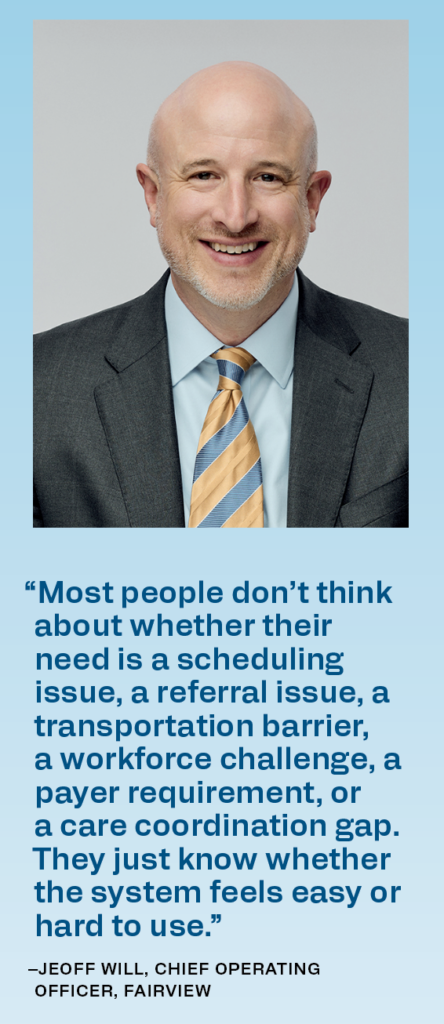
Fairview COO Jeoff Will says the solution starts with better design. “Most people don’t think about whether their need is a scheduling issue, a referral issue, a transportation barrier, a workforce challenge, a payer requirement, or a care coordination gap,” he says. “They just know whether the system feels easy or hard to use.”
 How difficult the system feels can sometimes also depend on a patient’s ZIP code. In urban communities, clinic closures and long waits can deepen existing disparities. In rural areas, losing one clinic, specialist, or department can eliminate the only nearby option.
Where Access Falls Short
Maternity care is one of the clearest examples. In 2023, 37 of Minnesota’s 87 counties had no hospital-based obstetric services, including 45% of rural counties and 37% of urban counties. In the state’s least populated rural counties, that number rose to 60%.
Recent closures have included maternity units in New Prague, Fosston, Fairmont, and Faribault. Between 2010 and 2023, 14 Minnesota counties lost hospital-based obstetric services entirely, leaving about 700,000 Minnesotans without nearby maternity care, according to a 2026 University of Minnesota report. For expectant parents, that loss can mean more time off work, added childcare, and longer drives for even routine prenatal appointments. Rural communities face additional barriers. Health systems in these areas serve smaller, older populations, and operate with fewer resources than metro providers. More of their patients also rely on public insurance, leaving those systems with less financial flexibility.
“Long travel distances, limited transportation options, and financial challenges, including being uninsured or underinsured, can delay preventive care and treatment,” says Dr. Melissa Marvin, a family medicine physician at HealthPartners’ Olivia Hospital and Clinic.
Rural Minnesotans travel three to six times farther than metro residents for hospital care. In the state’s most rural counties, travel for cardiology and neurology care increased about 33% from 2010 to 2019, according to 2022 American Hospital Association Survey data.
“Pediatric subspecialties often require travel to larger regional centers, as do specialties such as endocrinology, gastroenterology, and neurosurgery,” Marvin says.
But living closer to care doesn’t always mean getting it sooner. In a 2025 Minneapolis-area survey conducted by AMN Healthcare (a leading U.S. healthcare workforce solutions and staffing company), the average wait across six specialties was 38 days. Dermatology had the longest wait at nearly 90.
For someone with a chronic illness, needing mental health support, or waiting for potentially life-changing answers, those delays can mean worsening symptoms, repeated phone calls, and mounting anxiety.
The effects can spread throughout the entire system. “The closing of rural facilities pushes patients into urban and suburban facilities, impacting available beds and ER wait times,” Roach says. Closures can also ramp up costs for patients who must seek care at nearby hospitals.
But Minnesota’s providers aren’t standing still. “Hospitals and clinics are often the visible face of those problems,” Will says, “but solving them requires the broader healthcare ecosystem to work differently together.”
Rethinking Healthcare
Dr. Jaya Kumar, chief medical officer at Fairview, believes making care easier to reach starts with a shift in perspective. “The biggest misconception is that access is only about adding more appointment slots,” says Kumar. “Capacity matters, but access is really about whether patients can get the right care, in the right place, at the right time, with the right support around them.”
Health systems are expanding telehealth, using team-based care models, and bringing specialty services into community hospitals and clinics. Technology is also helping reduce administrative burdens, so clinicians can spend more time with patients.
 For Fairview, Will says they are focused on what they can control: “building a system that is easier to choose, easier to enter, easier to navigate, and easier to return to when patients need the next step in care,” he says.
“At HealthPartners, our care group is working to make care accessible by connecting patients to the right care, at the right time, and in the right setting,” Marvin says. “For example, telehealth visits allow many patients to receive follow-up care, specialty consultations, and chronic disease management without traveling long distances. We also help patients navigate our broader network of specialists, hospitals, and services when care isn’t available closer to home.”
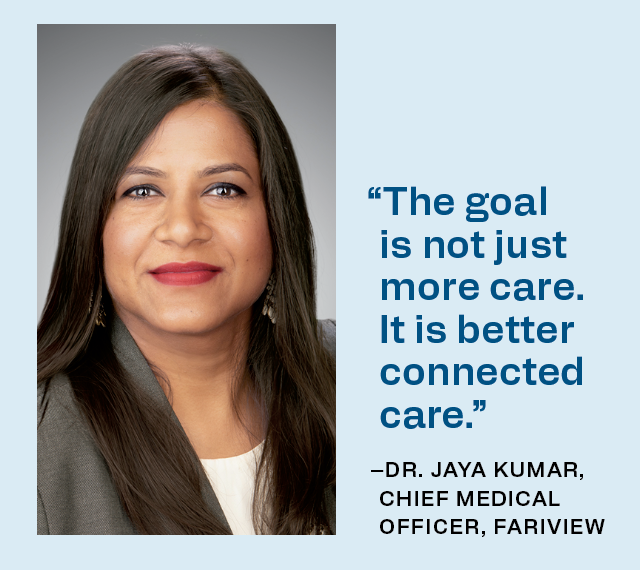
For many providers, the broader mission is to make the patient journey easier to navigate. “The goal is not just more care. It is better connected care,” Fairview’s Kumar says. That often means supporting patients long before they reach the exam room.
Basic Needs and Broader Change
Community partnerships help clinics address everyday barriers like transportation, food insecurity, and medication costs, while advocacy groups work to change policies that shape access to care.
HealthPartners’ care teams help patients meet practical needs through gas cards, bus tokens, and grocery gift cards. The organization also works with community groups to offer a mobile food shelf with wellness checks and local resources, as well as dental outreach clinics several times each year. “These efforts reflect our commitment to caring for the whole person and improving health through local partnerships and the broader resources available across our system,” Marvin says.
Those supports can make the difference between getting to a follow-up or missing it, filling a prescription or putting it off, or receiving preventive care before a minor concern becomes an emergency.
Health Care for All Minnesota is working to help lawmakers and the public view healthcare as an essential human need while advocating for a single, statewide, publicly funded system that would replace private insurance with universal coverage for all Minnesotans. “We must treat healthcare as the human necessity it is,” says Roach.
Change won’t happen overnight. But across the state, providers, advocates, and community partners are working together to make quality healthcare a reality for every Minnesotan. –Blair Sharp
The Future of Care
Technology is redefining what it means to receive healthcare. Virtual visits, remote monitoring, artificial intelligence, and other emerging advances are beginning to change not only where care happens, but also how illnesses are detected, treated, and prevented.
For Dr. Karthik Ghosh, a general internist and vice president for Mayo Clinic Health System, that transformation begins with a familiar refrain. “When I am out in the community talking to people about their needs,” she says, “one of the things I hear over and over is, ‘I’d love to be at Mayo, but I just can’t access it.’”
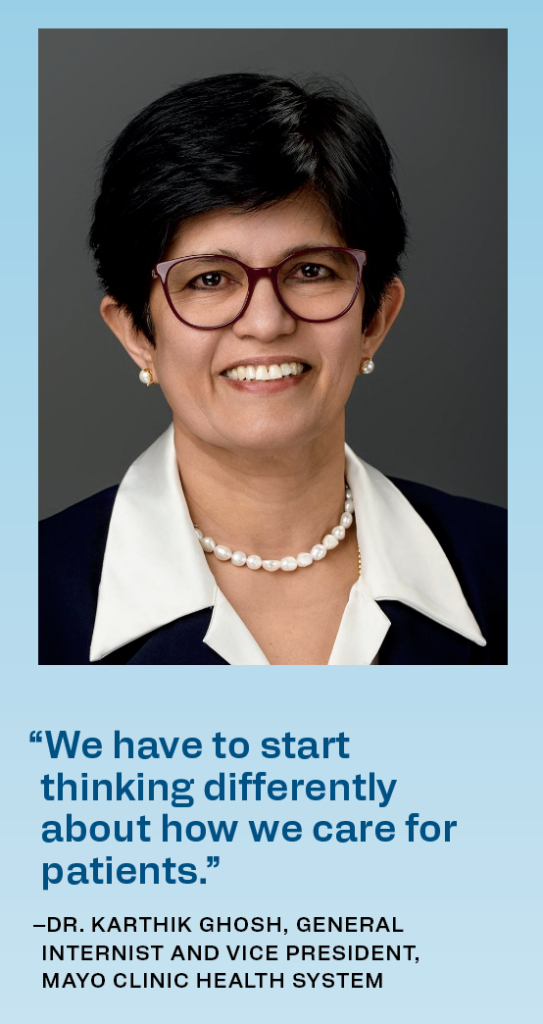
Rather than seeing those comments as discouraging, Ghosh views them as a challenge to rethink how healthcare is delivered. “We have to start thinking differently about how we care for patients,” she says. “That traditional one-on-one model is stretched thin. There are not enough doctors and clinicians out there to provide care in the way it was done in the past.”
The goal, she says, isn’t to replace the relationship between doctors and patients—it’s to rethink how that relationship works. Routine questions, follow-up visits, and chronic disease monitoring can increasingly happen virtually or with the help of digital tools, allowing clinicians to spend more of their in-person time caring for patients with complex conditions or urgent medical needs. Technology becomes less about replacing physicians than extending their reach.
But, she adds, the future is far from bleak. “We have the tools in our hands to transform medicine—to make it more patient-centric.”
 That revolution is already underway. Health systems across Minnesota are expanding virtual visits, remote monitoring, and AI-assisted tools that help clinicians diagnose illnesses faster, coordinate care more effectively, and connect patients with specialists regardless of locale. Many of these innovations are happening behind the scenes. AI can summarize medical records, assist with documentation, and organize information so clinicians spend less time transcribing and more time talking with patients. For patients, that can mean faster diagnoses, more personalized treatment, and easier communication with their care teams.
Virtual Visits
If you stretch the definition, remote medicine has existed in Minnesota for decades. “The earliest remote communications with patients were as simple as telephone calls,” says Dr. Mark Sannes, HealthPartners Care Group’s chief medical officer. Then, the widespread adoption of electronic health records in the early to mid-2000s made it possible for patients to directly communicate with their doctors via their computers.
The Mayo Clinic app, introduced in 2012 and continually enhanced in the years since, helps build that personal connection, making it possible for people to have direct access to doctors through their smartphones.
“We do primary care on demand, when and where patients need it,” Ghosh says.
Perhaps you’re a busy parent of three, Ghosh says. “One kid has a cough, but it’s hard to take that child and their siblings into the clinic.” Now, that parent can log into the app and get connected with a Mayo Clinic doctor within minutes—without having to leave their home.
Remote visits with a physician used to feel like a sorry substitute for “real,” in-person care, Ghosh says, but with technological advances, that’s not the case today. “Virtual care has come a long way. What we are doing as a health system, using the tools that are rapidly developing, has helped us to stay connected to our patients and provide high-quality care closer to their homes when they need it, rather than depending on when the clinic is open.”
As technology has advanced, so have the ways it can be used to improve care. One example is HealthPartners’ nurse line, Sannes says. These call lines have historically connected patients with nurses who can assess their conditions and make recommendations for care, often saving a trip to urgent care or the ER.
Advancing technology has further expanded the services these lines provide, connecting callers with acute needs to HealthPartners’ team of “virtualists,” remote physicians trained to assess patients and prescribe care over the phone—and create remote visits within minutes.
Sannes says that this rethinking of the way primary care is delivered has encouraged his colleagues to look at all care delivery differently. “What’s to say we can’t do this in specialty care as well? What’s to say that we can’t take this approach in cardiology or pulmonology or infectious disease? The opportunities feel endless.”
Even as technology reshapes healthcare, some aspects of medicine remain unchanged. A difficult diagnosis, a physical examination, or a conversation about treatment options still depends on trust and human connection. Healthcare leaders say the future isn’t about replacing those moments with technology—it’s about using technology to make them more meaningful by giving clinicians more time to focus on the people in front of them.
It’s a Small(er) World
Health systems across Minnesota are using technology to expand access and connect patients with physicians across geographic divides. Remote monitoring, for example, allows patients to measure vitals at home and send information directly to providers. “Not every issue requires a visit to the clinic,” Sannes says.
HealthPartners also brings specialty care directly to rural communities through outreach clinics. “I do an outreach clinic in Hutchinson once a month,” Sannes says. “This is a great service for people who don’t want to travel into the metro.”
Mayo Clinic Health System takes a similar approach with its mobile “Big Blue” clinic, equipped with exam rooms, an on-site lab, and telehealth technology. “When patients can’t access us virtually because of broadband issues,” Ghosh says, “we take our team to them.”
AI for Good
When it comes to improving health outcomes and saving lives, Dr. Sanjay Singh, Allina Health’s chief clinical executive, is bullish on artificial intelligence. At Allina, and in others across the state, the technology is being used to analyze scans and test results to detect disease and help clinicians determine treatment more quickly.
A good example is the detection and treatment of strokes through teleneurology and telestroke services. When a patient comes into one of Allina’s outstate clinics with stroke-like symptoms, their scans are immediately evaluated by an AI algorithm that monitors most CT scanners across Allina Health.
The algorithm “picks up a stroke in under six minutes,” Singh says. When a possible stroke is identified, the system immediately alerts specialists in the metro area, who review the findings, confirm the diagnosis, and develop a treatment plan. Patients are then routed to the right hospital for the care they need.
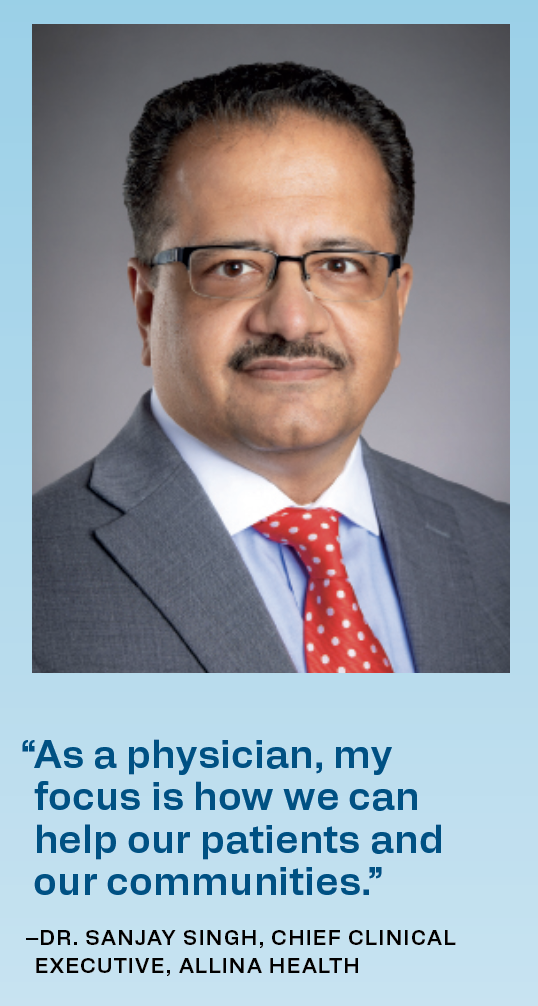 Stroke detection is only one example of AI’s growing role in healthcare. Health systems are also using the technology to help clinicians identify patterns in medical records, streamline documentation, prioritize patient messages, and reduce administrative tasks that contribute to physician burnout. Rather than replacing doctors, these tools are designed to support clinical decision-making, giving care teams faster access to information while allowing them to spend more time focused on patients. “As a physician, my focus is how we can help our patients and our communities,” Singh says. “These new technologies allow me to treat my patients, reduce their suffering, and get them cured.”
Even as AI becomes more sophisticated, healthcare leaders say its greatest value lies in enhancing—not replacing—the expertise and judgment of physicians. As the technology continues to evolve, balancing innovation with patient privacy, equity, and human oversight will remain just as important as the algorithms themselves.
Singh believes the pace of innovation will only accelerate. Over the next five to 10 years, he expects artificial intelligence, medical technology, and other advances to further change how clinicians diagnose disease, personalize treatment, and care for patients. “We are going to be able to help patients in ways we have not been able to do before,” he says.
The Road Ahead
As technology becomes more embedded in care, health systems will also have to confront its limits. Patient data must remain secure, algorithms require human oversight, and digital tools must be designed, so they don’t widen disparities for people without reliable broadband or confidence using technology.
Virtual care can improve convenience and reach, but it cannot replace every physical exam, procedure, or face-to-face conversation. Cost and insurance coverage will also help determine whether these advances become broadly available or remain out of reach for some patients. “Technology can help, but only when it solves a real problem,” says Jeoff Will, Fairview’s chief operating officer. “Virtual care, digital tools, AI-supported documentation, and workflow redesign are most valuable when they reduce friction for patients or give time back to care teams. The goal is not technology for its own sake.”
Fairview’s Chief Medical Officer Jaya Kumar, M.D., adds, “Tools like AI-supported documentation and thoughtful workflow redesign can help if they are implemented in a way that supports clinical judgment, increased face-to-face time and connection with patients, and gives time back to care teams.”
The next generation of healthcare is unlikely to replace the doctor’s office entirely. Instead, many changes may happen quietly. Virtual follow-up visits, AI-assisted documentation, remote monitoring, and digital care navigation will become routine, while specialists consult from hundreds of miles away and algorithms recognize risks before emergencies. Ultimately, the future of healthcare won’t be defined by technology alone, but by whether it makes care more accessible, connected, and human. In a state built on healthcare innovation, standing still has never been the prescription. –Andy Steiner
Discover the physicians shaping health care across Minnesota in our 2026 Top Doctors issue, featuring nearly 1,000 doctors across 100 specialties.