



Photo by John Haynes
It’s a scene straight out of “Cheers”—the kind where Norm walks through the door and everyone knows his name. Only on this Wednesday afternoon at Dexter’s in Edina, it’s Frank Vascellaro and Amelia Santaniello drawing the warm welcomes. Before they’ve even settled in, someone stops to say hello. Then another. Greetings travel across the room, familiar faces light up, and a few hugs are exchanged. For two of the Twin Cities’ most recognizable television personalities, the reception feels less like celebrity recognition and more like a couple of beloved regulars returning to their favorite neighborhood haunt.
Which, of course, is exactly what they are. The timing of our conversation seems particularly fitting. Frank and Amelia celebrated their wedding anniversary just the day before. More than 25 years after exchanging vows in Florence, Italy, they’re sitting together at a restaurant close to home, talking less about the television careers that made them household names across Minnesota and more about the life they’ve built together beyond the anchor desk.
For decades, Minnesotans have welcomed Vascellaro and Santaniello into their homes. At the appointed hour, there they are, sitting side by side at the WCCO anchor desk, moving through the day’s news with the comfortable rhythm of two people who know each other extraordinarily well.
Because they do. But the life they have built together has always been about much more than what happens under studio lights. It has been shaped by the same things that fill so many Minnesota lives: three kids and packed schedules, dinners squeezed between obligations, grandparents nearby, youth sports, weekends at the cabin, beloved pets, college football, good friends, and the occasional marital disagreement that really ought to be resolved before the cameras turn on.
They don’t even drive to work together. “When we first started working together, he said, ‘So, what time do you want to leave?’ And I said, ‘No, no. We’re not doing that,’” Santaniello recalls.
“Too much together time for Amelia,” Vascellaro says.
“I like my car,” she replies. “That’s where I decompress.”
It’s a wonderfully ordinary boundary for a couple whose lives have become unusually intertwined.
Long before they became “Frank and Amelia,” they arrived in Minnesota separately, each following a very different path. Santaniello grew up moving frequently, the daughter of a father from Scranton, Pennsylvania, and a mother from Japan. She imagined becoming a teacher until an aunt suggested journalism. The career changed; the impulse behind it did not. She still sees journalism as a form of teaching—a way of helping people understand what is happening in their backyard, their community, and the wider world.
Vascellaro came to broadcasting later. He was nearly 27 when the death of his father, a pilot who loved his work, forced him to consider whether he could say the same about his own life. “It made me stop and reexamine my life and ask, ‘What do I really want to do?’” He had worked at two Wall Street firms, but memories of watching the evening news with his parents on a little black-and-white television in the kitchen kept tugging at him.
He went back to school for journalism and eventually accepted a reporting job in Decatur, Illinois, earning about $14,000 a year. It was hardly a conventional path to a major-market anchor desk, but looking back, Vascellaro sees the timing as part of the story. “Sometimes I wish I had found my purpose five or six years earlier, but if I had, I wouldn’t have been on this path.”
And that path led to Minnesota.
Santaniello arrived at WCCO in 1996, beginning what is now a 30-year run at the station. Vascellaro landed in Minnesota around the same time, joining KARE 11 and eventually moving to the evening anchor desk after longtime anchor Paul Magers departed. But one of the most important people Vascellaro met here wasn’t in a newsroom.
Frank and Amelia met at a charity event just months after he arrived. They married in 1999, though even their wedding began with an unlikely bit of Minnesota serendipity. One day, while waiting for Santaniello to shop for shoes at Mall of America, Vascellaro spotted a penny. “I picked it up—a lucky penny.”
Not long afterward, they attended a fundraiser where he bought a raffle ticket for two business-class tickets to Europe. He spent the evening confidently announcing that he was going to win. “He was obnoxious about it,” Santaniello says. Then his number was called. “And then they pulled the ticket,” Vascellaro remembers. “I jumped over the railing and ran up there.”
The tickets took them to Italy, where they married in Florence before returning home to celebrate with family and friends. “I’d do it that way again,” he says. Sitting at Dexter’s the day after another anniversary, the story feels less like an anecdote from another lifetime than the beginning of everything that followed.
Their marriage came together before their careers did. For years, they went home to each other after spending their workdays at rival television stations. They were competitive—very competitive, they both concede—but they developed an early habit that would later prove useful: They didn’t bring much newsroom talk home.
Then, in 2006, after nine years at KARE and a six-month noncompete, Vascellaro joined Santaniello at WCCO. Suddenly, marriage and work were separated by just eight inches at the anchor desk. And it was harder than either expected.
“I naively thought, ‘Oh, well, we’re married. It’s going to be fine. We’re gonna just jump right into this,’” Santaniello says. Vascellaro agrees: “It was much more difficult transitioning than I thought.”
Television usually asks two people who barely know one another to sit shoulder to shoulder and somehow create chemistry. Frank and Amelia had the opposite problem: They knew each other so intimately that they had to figure out how to bring a marriage into a professional setting without allowing one to overwhelm the other. Eventually, that familiarity became an advantage. They could be direct because neither had to wonder about the intention behind it. “There’s a level here that he’s not gonna get offended, and I’m not gonna get offended, because we know it’s coming from a place of love,” Santaniello says.
There was also a rule: Whatever happened at home had to be settled before airtime. “The camera doesn’t lie,” she says. It’s funny, but it also says something about the marriage. Long before audiences knew them as a husband-and-wife anchor team, they understood that protecting both their relationship and their work required knowing where one ended and the other began.

W10=
Life Between the Newscasts
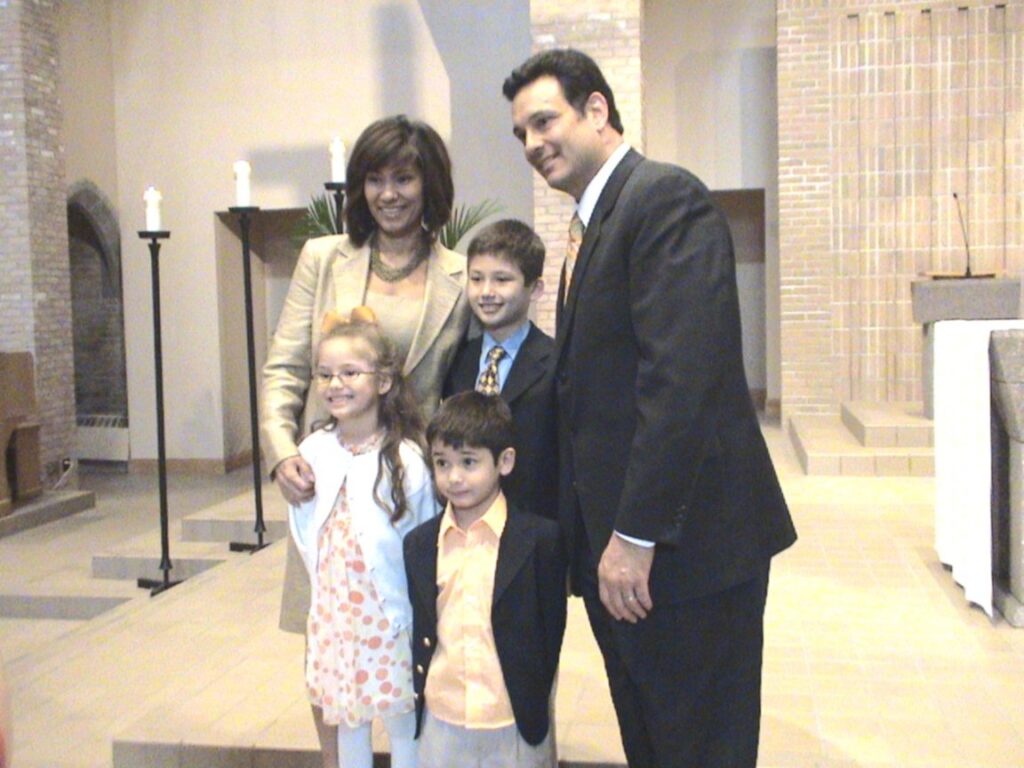
The real test of that balance came not at the anchor desk but at home. They had three children—Sam, followed by twins Francesca, known as Frankie, and Joe—and built family life around the unforgiving clock of live television.
Vascellaro’s mother lived two blocks away and became an indispensable part of it. After Vascellaro’s father died, the relationship worked both ways: Grandma gave two working parents the help they desperately needed, while the children gave her something, too. “My mom was a lifesaver, and it was the greatest thing in the world for our family,” he says. The children, she says, brought their grandmother “such purpose and joy.”
Their proximity to WCCO helped. Frank and Amelia could sometimes race home between newscasts, eat dinner with the kids, then head off to somebody’s game or practice—Vascellaro occasionally still dressed for the evening news. “Often in a suit and tie,” he says.
For two people whose faces were known across Minnesota, they worked hard to make television seem thoroughly unremarkable inside their own house. “We wanted them to realize that even though their parents had high-profile jobs, that, you know, it was just a job, right?” Santaniello says. “Firefighter, teacher, TV anchor, whatever. Just our job.”
Their children apparently got the message. When Vascellaro once suited up with the Harlem Globetrotters at Target Center and struggled to make a basket in front of thousands of people, his basketball-playing kids were mortified. “It was horrible,” Santaniello says.
“There were about 16,000 people there. A lot of pressure,” Vascellaro counters, before conceding: “I looked ridiculous, and I played ridiculous.”
Today, the frantic years of raising three children have given way to a different rhythm. For five seasons, fall Saturdays revolved around St. John’s University football, where their son played. Summer weekends still frequently mean the family cabin in Wisconsin. Otherwise, they are home, meeting friends or going out to dinner.
And then there is college football. Early in their relationship, Vascellaro informed Santaniello that he watched college football on Saturdays. She reasonably interpreted this to mean a football game. It did not.
“As we dated longer, I realized he meant he watches all the games,” she says. Vascellaro insists there was no fine print: “I was very clear: I like dogs, the outdoors, I’m kind to my mother, and I like watching college football. Are you in?”
Dogs, it turns out, belong high on that list. Lola and Louie grew up alongside the children and took on an even bigger place in the household once those children left for college.
“When the kids went off to school, then we were empty nesters, and these were our children, like our furry children,” Santaniello says. Losing them was harder than either expected. “Nobody warns you about it,” she says.
Perhaps that was because the dogs had become part of the connective tissue of the family, particularly as the house grew quieter. When the kids returned from college, the dogs would lose their minds with excitement. “The reunions were amazing,” Vascellaro says.
Finding Home
Back at Dexter’s, there’s another hello, another familiar face. It would be easy to view those interactions simply as the inevitable consequence of being on television for decades. But watching them unfold, they feel more personal than that. Frank and Amelia aren’t simply recognizable here. They are rooted here. Neither came to Minnesota expecting that. Santaniello remembers interviewing for jobs in three different places before coming to WCCO. Minnesota felt different almost immediately. “It just felt like home when I interviewed here,” she says.
What began as a career move became the place where she met her husband, raised three children, built friendships, lost people she loved, watched her children leave home, and accumulated the small rituals that turn geography into belonging. “We feel so blessed and so grateful to have made this our home,” she says. “For our kids, you know, I mean, this is home for them.”
Vascellaro feels much the same. There is gratitude in having landed in a place where they could build careers without having those careers become the entirety of their lives. “I’m just really grateful that we landed in a wonderful community,” he says, one that became “a great, healthy, good environment to raise our kids and be a family.”
That connection becomes especially visible at the Minnesota State Fair, where the peculiar one-way intimacy of television suddenly becomes a conversation. People who have watched Frank and Amelia from their living rooms for decades can walk up and talk to them.
And yes, they really do love the fair. “A lot of people in our business say they love the fair. Because you have to say you love the fair,” Vascellaro says. “But we actually love it there.”
“We both do,” Santaniello says.
It’s tempting to tell the story of Frank and Amelia through the big numbers: 30 years at WCCO for her, 20 for him, more than two decades of marriage, three children, thousands upon thousands of newscasts. But sitting with them the day after their anniversary, the smaller things seem more revealing.
The lucky penny. Dinner between newscasts. A grandmother two blocks away. A husband watching far more football than his wife bargained for. Dogs waiting at the door for children coming home. Separate cars to the same workplace. Weekends at the cabin. Friends who became family. Hugs exchanged across a neighborhood restaurant on an ordinary Wednesday afternoon.
For decades, viewers have watched their family change alongside their own: babies became children, children became adults, and Minnesota gradually stopped being the place Frank and Amelia had moved to and simply became home. Their very public profession, Santaniello says, doesn’t define who they are in their personal lives. What does is much closer to home: their children, their friends, and the community that became theirs.
After all those years of being invited into Minnesota homes, Frank and Amelia discovered something in return. They had found theirs.