


In 1991, the Minnesota Twins and Atlanta Braves battled for seven games in one of the most exciting World Series in history. The Twins won their second World Series by winning all four of their home games, typically in dramatic fashion. Three of the series’ seven games went to extra innings. Four games were won by the final swing of the bat. Five games were decided by one run.
Beyond the thrills of each game, the ’91 World Series was also an unprecedented affair. Never before had a team that finished in last place the previous season made it to the World Series. In 1991, both the Braves and Twins had gone from worst to first in their respective divisions. For participants and spectators alike, the 1991 Fall Classic was a deeply meaningful moment in baseball history—one that is similarly revered in Minnesota and Atlanta.
“That ‘91 team was the most fun and the closest-knit team I ever played with,” says Brian Harper, the starting catcher for the world champion Twins. Harper had been on great teams in other cities. As a rookie in 1979, he played for a star-studded California Angels team that won the American League (AL) West. In 1985, he caught for the National League (NL) champion St. Louis Cardinals who won 101 regular season games and came within an atrocious Don Denkinger call of winning the World Series. Harper says that ’91 Twins team was different.
The Tom Kelly managed Twins were a great mix of veterans and youngsters who played with energy and enthusiasm. A core of Minnesota’s stars had been there back in 1987 when the Twins outlasted the Cardinals in a similarly fraught seven-game World Series. This group included fiery outfielder Dan Gladden, Bloomington-bred slugger Kent Hrbek, and Kirby Puckett, Minnesota’s all-world centerfielder who was later immortalized in the Baseball Hall of Fame. The team’s youngsters included emerging pitchers Scott Erickson and Kevin Tapani as well as fireplug second baseman Chuck Knoblauch, who was named AL Rookie of the Year that season. Topping it all off was St. Paul native and starting pitcher Jack Morris, the local boy who came home for the 1991 season and cemented his place in baseball lore as one of the sport’s great big game pitchers.
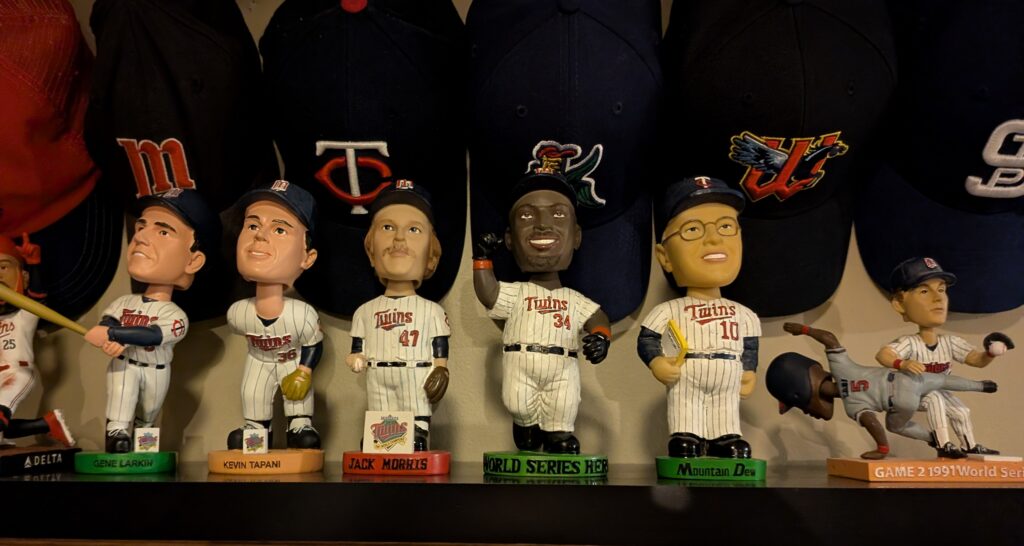
Courtesy of Todd Hanselman
Harper credits teammates like Puckett with keeping the mood and energy up in the clubhouse.
The 1991 World Series had its share of controversies on and off the field, but that didn’t spill over into any heat between the teams.
“There wasn’t any tension. It wasn’t like we had any animosity with the Braves. Our team wasn’t like that. Our teams were really similar, having finished last the previous year. We were all just ecstatic to be in the World Series,” Harper says.
The Braves and Twins chartered similarly unprecedented paths to the World Series.
Several years removed from their World Series victory, the Minnesota Twins fell apart in 1990, finishing the season in last place in the AL West with a 74-88 mark. During the subsequent offseason, Twins general manager Andy McPhail kickstarted his rebuild of the Minnesota roster with a pair of free agent signings.
Designated hitter Chili Davis came over from the California Angels and had one of his best seasons, belting 29 homers and driving in 93 runs. With the departure of slugger Gary Gaetti after the 1990 season, Davis joined Hrbek and Puckett as the 1-2-3 punch in the middle of the Minnesota lineup.
Minnesota’s signing of Detroit Tigers ace Jack Morris proved even more decisive. The Highland Park High School graduate had won more games than any other pitcher during the 1980s but slumped through the 1990 season. Minnesota seemed like just the place for Morris to rejuvenate his career.
Harper recalls that Morris pitched with an edge, to say the least.
“When he pitched, he was a mean grouch. And he would even say that. He pitched in a zone where he was angry. The four days when he didn’t pitch, he was a really good guy,” Harper says.
Despite the additions to Minnesota’s roster, the Twins struggled out of the gate to a 2-9 start in April. Rumors abounded in the baseball press that Tom Kelly would be fired. Internally, the team was confident that they’d get better.
“[Kelly] didn’t over manage. There’s a lot of coaches that overcoach. He demanded that you hustled and played hard,” Harper says. He says the Twins roster was full of leaders who held one another accountable. If a player didn’t run out a ball, they’d hear about it from the veterans, especially Puckett.
Moreover, Kelly’s track record offered him some leeway when it came to early season struggles.
“After the ‘87 season, Tom Kelly was certainly perceived as a great manager. You win a World Championship, and you get a lot of capital from that,” says Minnesota sports historian Stew Thornley, an official online game-caster for the Twins and one of the great authorities on Twins history.
The team remained sluggish until the end of May before catching fire in June, winning 15 consecutive games, and taking a lead in the AL West that they would never relinquish. The Twins finished the regular season with a 95-67 record, best in the American League.
All of these victories had many authors in the Twins clubhouse, including its starting pitchers. A thirtysomething Morris won 18 games while 23-year-old sinker baller Scott Erickson won a league best 20 games with an earned run average (ERA) of just over three. Twenty-seven-year-old right-hander Kevin Tapani won 16 games with an ERA of just under three.
Harper recalls that Erickson shared a fire similar to that of Morris.
“On the days he pitched, he was really intense. He called it the ‘Day of Death’ or something like that,” Harper says.
In addition to strong performances by the team’s veteran core, young right fielder Shane Mack batted over .300 while rookie second baseman Chuck Knoblauch proved a versatile threat with his bat, glove, and legs.
After a sluggish start at the box office, fans started packing the HHH Metrodome and renewed its reputation as one of baseball’s loudest venues.
“It didn’t really kick in until we went on that winning streak. Then everybody started thinking we’ve got a pretty good team here,” Harper says.
Rod Collins, a longtime Twins employee, believes that momentum from the surprising Minnesota North Stars hockey team in the Spring of 1991 prepared the region’s sports fans for a similarly compelling summer of Twins baseball.
“That was the same spring that the North Stars went to the Finals,” Collins, then a North Stars season ticket holder, says. “It was a nice carryover to the Twins. All the hockey fans have just gone through a Stanley Cup run. We thought maybe this magic will keep going on from here.”
Collins started working as an usher for the Twins in 1989 and held a range of supervisory and front office roles with the organization through 2001. This included a two-year stint as the backup TC Bear.
Collins and his bride-to-be planned to get married in fall 1991.
“I knew it was a year when the American League would have the home field advantage, and if we got to the World Series, we would be hosting games one, two, six, and seven. I said to my wife ‘if this happens. These are the weekends that are going to be occupied,” Collins says. They married on October 12th, before the World Series.
While Collins and his wife were saying, “I do,” the Twins battled it out in the American League Championship Series (ALCS) with the Toronto Blue Jays, an already dangerous team that was bolstered in the offseason by the acquisitions of perennial All Stars Roberto Alomar and Joe Carter. Minnesota won the series four games to one, but it was a genuine tussle. These Toronto Blue Jays would win back-to-back World Championships in 1992 and 1993.
It took a pair of wins by postseason dynamo Jack Morris and a .429 batting average from series MVP Kirby Puckett to power the Twins past Toronto.
“We struggled against Toronto in ‘91. It wasn’t a situation where we were overly confident. They were a really good team. They would win the World Series the next two years. And they had beaten us pretty good during the season,” Harper says.
Atlanta cut an even more unlikely path to the postseason. The Braves hadn’t had a winning season since 1983. The franchise had finished last in the NL East in each of the three previous seasons and drew flies to Atlanta Fulton County Stadium.
Braves general manager John Schuerholz and manager Bobby Cox knew that a change was coming soon. They had cultivated an excellent young nucleus that included sluggers David Justice and Ron Gant as well as emerging pitching aces Tom Glavine, John Smoltz, and Steve Avery. In the offseason, they acquired base stealing machine Otis Nixon from Montreal and third baseman Terry Pendleton from St. Louis, who posted a career year and won the NL MVP award.
“The Braves organization saw 1991 coming. We had all these great young pictures. There was a lot of internal optimism. They were all so young. The fans didn’t see it,” says Bryan Bartholomay, who was 10 years old at the time. Bartholomay was the grandson of Braves chairman Bill Bartholomay, who had helped bring the franchise to Atlanta back in 1966. Bryan was his grandfather’s best friend and traveled with him to every game in the 1991 postseason.
Atlanta sat 9.5 games back from the first-place Los Angeles Dodgers at the All-Star Break, posting a surprisingly competitive 39-40 mark through the first half. The Braves got hot that summer and pushed past the Dodgers in the season’s final month.
“Atlanta wanted to fall in love with something. Baseball was right there,” says Yahoo! Sports college football writer Stephen Godfrey. At the time, Godfrey was a 10-year-old Atlanta Braves fan. He lived in the Washington DC metro area, but his family was from Georgia.
“I didn’t really understand the magnitude of worst to first because of my age, but I was watching my parents react to it and see how important it was. Every single game seemed so important, especially in the second half of that season,” Godfrey says.
After the Braves won the NL East, his grandfather drove up from Georgia, picked up Stephen and his father, and brought them to Pittsburgh for Game 2 of the National League Championship Series. The Braves would end up defeating the Pirates in seven games. John Smoltz through a complete game shutout to secure the Braves’ first trip to the World Series since the franchise called Wisconsin home.
When the Atlanta Braves came to the Metrodome on Saturday night October 19th for the first game of the World Series, they were greeted by 50,000 homer hankies, the Twins rally towel that had been introduced during the 1987 postseason, and one of the most daunting road atmospheres in baseball. In the 1987 and 1991 World Series, the Twins went 8-0 at the Metrodome. They lost all six games played in St. Louis or Atlanta.
“That place was so loud, I can’t tell you. I don’t know what to compare it to,” Bartholomay says.
“We definitely had an advantage at the Metrodome. The ceiling was kind of hard to see. Most outfielders and most infielders in the outdoor stadiums need to take their eye off the ball, run to where they think it is and then go catch it. In the Metrodome, you really couldn’t take your eye off the ball,” Harper says.
Nevertheless, the Metrodome was trying even on its regulars. Harper notes that playing on the stadium’s hard turf left you sore all over after a homestand.
“I think people thought of it as kind of a crap venue from the beginning. The first year they didn’t have air conditioning, and then the bouncy turf and the dark roof with balls getting lost up there,” Thornley says. Years later, Thornley was surprised to learn the affection that many younger fans felt for the Metrodome, as it was the venue in which they learned to love baseball.
Air conditioning would prove to be a bone of contention in the series, as the Braves claimed that the system was set to help blow Twins fly balls further in later innings. In 2003, former Metrodome superintendent Dick Ericson conceded to the Star Tribune that he would adjust the ventilation at times to help Twins fly balls carry further late in games. At the time of the 2003 report, Twins officials said they had no knowledge of Ericson’s efforts.
“People were talking about the air conditioning that night [game one]. I was very cold and I needed another jacket, but I didn’t put two and two together. I mentioned that to my granddad and a day later it became a thing,” Bartholomay says.
“The Metrodome was played up on the CBS broadcast like it was some kind of House of Horrors. The air conditioning in the Metrodome was treated in my family like it was Saddam Hussein. It was a Minnesota conspiracy to affect our outfielders. The hockey boards that ran across the outfield were also somehow conspiratorial against the Braves. And of course, [CBS commentator] Tim McCarver was out to get us,” Godfrey says.
The Twins defeated Atlanta 5-2 in game one behind seven innings of strong work from Jack Morris and two scoreless innings by Minnesota relievers Mark Guthrie and Rick Aguilera.
“I had never been around that kind of environment before. [game one] was so intense, but I enjoyed the heck out of it,” Collins says. After that game, Collins came up close and personal with Atlanta’s biggest celebrities. He escorted Braves owner Ted Turner and his then-wife Jane Fonda to their taxi.
During the series, Fonda, in particular, got guff from some in the press for doing the “Tomahawk Chop” during the games in Atlanta, the controversial hand motion which drew protests from Native American groups before the games at the Metrodome. Partaking in the “Chop,” which a number of observers regard as a harmful caricature, seemed to some to run counter to Fonda’s public image as a progressive.
Thornley recalls the Minnesota press trying out a numerous angles to drum up local animosity toward the Braves.
“Some of the news media went out of their way to find a way to not like Atlanta, bringing up the Confederacy and stuff,” Thornley says.
The Twins pushed past the Braves in game two, winning 3-2. Light hitting Minnesota third baseman Scott Leuis proved the unlikely hero, belting an eighth inning home run which proved to be the difference.
In game two, the controversy took place on the field. During the top of the third inning, Braves slugger Ron Gant retreated to first base after singling to left field. While Minnesota first baseman Kent Hrbek caught the throw over to first, he muscled Gant’s left leg off the base and tagged him. Surprisingly, umpire Drew Coble called Gant out, bringing the inning to an end with an Atlanta runner on third base. The play drew not only histrionics across the southeast but death threats for Hrbek. Twins supporters note that typically a base runner slides back into the bag. Gant did not.
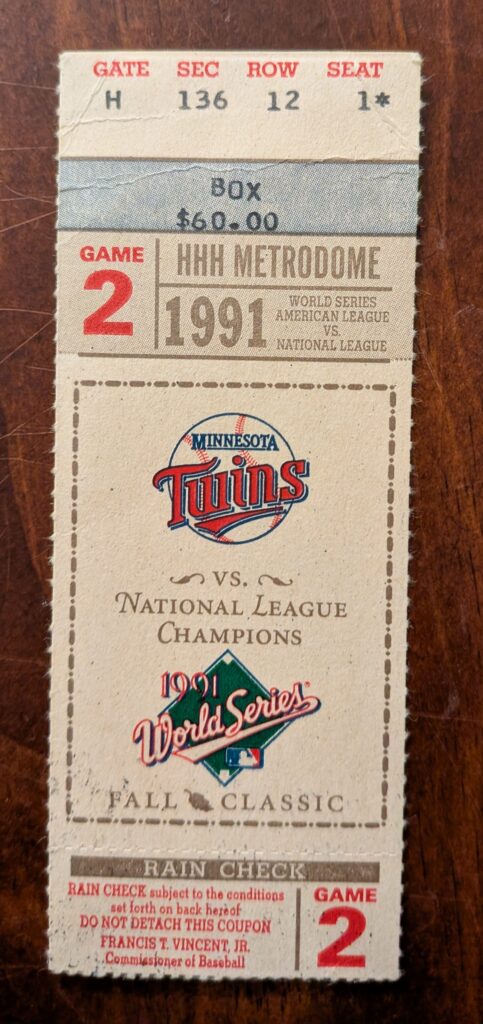
Courtesy of Todd Hanselman
“When you go back to a base, you slide. Gant went off the base. He might have had a little help, but if he would have slid, he would have made it,” Harper says.
“Kent Hrbek to this day is the classic wrestling heel to me. I remember thinking that Kent Hrbek was everything that was evil about Minnesota. Everybody finds a villain in sports, and it was the first time I found my villain. In my mind, he picked up Ron Gant and gave him the tombstone pile driver,” Godfrey says.
Twins fan Todd Hanselman attended game two and had mixed feelings on the matter.
“We didn’t get to see replay because those screens didn’t show those things anyway. It looked pretty controversial having played baseball most of my life. I saw it on ESPN the next day and thought my coaches would have said, ‘slide back into first.’ I wonder why he didn’t do that,” Hanselman says.
Hanselman grew up in Mankato and got to go to the game as a birthday present from his father. His father tracked down tickets through work, and they attended the game with a father and son from Fairmont that he had never met before or seen since.
“We met up with them in Fairmont and went up to the Twin Cities. We were listening to the Vikings game on the way up. They were playing the Patriots and lost. Jesse Ventura was the announcer and he was livid. He was bad-mouthing Jerry Burns and how they should easily beat the Patriots,” Hanselman says.
Hanselman recalls Kevin Tapani coming out before the game and waving a homer hanky to rile up the crowd.
As the series shifted to Atlanta, Braves fans feared the worst.
“Headed back to Atlanta down 2-0, all I remember was wanting the Braves to at least put up a fight and not get swept,” says Braves fan Bill Brown, who followed the team in Columbus, Mississippi. Ted Turner’s TBS network broadcast virtually every Braves game from coast to coast, but the team’s appeal was pronounced across the southeastern United States. At the time, the Braves were the only Major League Baseball team south of Baltimore and east of Houston. The southeastern United States was their domain and fans across the region had been able to follow the team closely on television since the early 1970s when Turner’s little Atlanta UHF station, WTCG, morphed into the satellite-deployed WTBS “Superstation.”
The Braves even had fans in Minnesota, thanks to the expansion of cable television across the state and the presence of Edina (then Edina East) High School and University of Minnesota baseball standout Greg Olson on the Braves’ roster. A strong defensive catcher, Olson had been the Braves’ lone All-Star Team selection in 1990.
The Braves proved just as impressive in Atlanta as the Twins had in Minnesota. The chants and chops of the Braves fans created a similarly unwelcoming atmosphere for the visitors. Atlanta won a 12-inning affair in Game 3 thanks to second baseman Mark Lemke, who singled home David Justice for the game winning run. If the Braves had won the series, Lemke would likely have been the MVP, batting .417 and delivering a cluster of clutch hits. Atlanta won 3-2 in Game 4 before demolishing the Twins 14-5 in Game 5. The Braves and Twins would head back to Minnesota with Atlanta just one game away from winning the series.
Sitting in the upper deck of Atlanta Fulton County Stadium for Game 5 was a University of Florida law school student named Hal Lewis. The previous December, Lewis went to Las Vegas with some college fraternity buddies. While at a Vegas sportsbook, Lewis put down a $100 bet that his favorite baseball team, the Atlanta Braves, would win the 1991 World Series. At the time, bookmakers put the last place Braves’ odds at 200-1. The payout would have been $20,000 (roughly $50,000 in 2026 dollars).
Lewis didn’t think much of the betslip until the Braves got hot in the summer of 1991.
“Needless to say, the next three months were the most exciting months of my entire Braves fandom. Miracle after miracle took place. By the time the World Series rolled around, I was actually starting to believe that my life was going to change,” Lewis says. He continued, “As fate would have it, this was one of the most nerve-wracking World Series in history. My entire fraternity and everyone in law school knew the story, so everyone had become Braves fans. They took up a collection and sent me up to Atlanta for Game 5.”
While Hal Lewis wished for one more Atlanta win, Twins first baseman Kent Hrbek expressed confidence on the flight home, reminding everyone that the 1987 World Series had gone the same way. The Twins won the four games in Minneapolis while the Cardinals won the three games in St. Louis.
The Twins stadium crew sought supernatural intervention. Collins remembers ushers burning a Braves baseball card in effigy and chanting over it before both games six and seven.
The most supernatural force in Game 6 proved to be Kirby Puckett. In the third inning, he robbed Ron Gant of extra bases with a catch against the plexiglass in centerfield. He drove in three of the team’s four runs, including the game winner. Puckett clinched a seventh game by leading off the 11th inning with a line drive home run to left-center field.
Jack Buck’s “and we’ll see you tomorrow night” call of Puckett’s home run on CBS’ television broadcast has become one of the most memorable in baseball history.
“When Puckett hit that ball, there was a sound where you could tell it’s going to go out,” Collins says. At the time, he was standing behind the centerfield wall, waiting to pull the pin on the centerfield door so that security personnel could take their positions on the field.
Game seven took place on Sunday night October 27th at a sold out Metrodome. Back in Mississippi, Bill Brown blew out his birthday cake at his parents’ home and watched the game.
“I blew out all 22 candles, which means you were supposed to get your birthday wish. And a classic unfolded,” Brown says.
Braves fan Art Johnson was on his mission for the Church of Latter-Day Saints in Japan during the 1991 baseball season. He followed the team’s rise through the American newspaper subscription of a member of his congregation.
“Prime time games in the U.S. air between 11 a.m and 2 p.m. the next day in Japan. I stopped at an electronic store window for a few minutes to watch what must have been a replay ending of a couple of Braves and Pirates games. I distinctly remember watching the last 30 to 40 minutes of the World Series Game Seven on a Monday afternoon at an electronic store street window,” Johnson says.
The 55,118 fans at the Metrodome and estimated 50.3 million television viewers across the United States (by comparison, Game 7 of the 2025 World Series, the most viewed World Series game of the decade, drew roughly 27 million viewers on television and all streaming platforms combined) watched one of the greatest games in baseball history.
Thirty-six-year-old Jack Morris faced 24-year-old John Smoltz in a pitching matchup of future Hall of Famers. Smoltz grew up in Michigan idolizing Tigers ace Morris, giving the matchup even more narrative juice.
Morris would throw a complete-game, 10-inning shutout for the win in extra innings. Smoltz pitched 7 1/3 scoreless innings of his own in the classic pitcher’s duel.
“Everything felt so monumental. Every pitch was a nail biter. It just went so quickly. It felt like a blur,” Bartholomay says.
Both teams nearly scored in the eighth inning. In the top of the eighth with Lonnie Smith on first base, Terry Pendleton smacked a ball into the gap in right centerfield. Braves outfielder Smith could certainly have scored on the play but ended up at third base, having stopped for a moment when rounding second. With runners at second and third, Minnesota walked David Justice. On the next play, Braves first baseman Sid Bream grounded into an inning ending double play, preserving the scoreless tie. In the subsequent decades, Lonnie Smith, who was a starter on three different World Series winning teams for three different franchises, has caught no end of grief from Braves fans for his base running blunder.
“Lonnie Smith was such a great person. It was really tough,” Bartholomay says.
In the bottom of the eighth inning, the Twins loaded the bases with one out. Smoltz’s replacement, reliever Mike Stanton, got Hrbek to ground into an inning ending double play to preserve the tie.
After nine innings, the game remained scoreless. Rather than sending Morris out for the tenth, Twins manager Tom Kelly and pitching coach Dick Such planned to bring in reliever Rick Aguilera.
“Tom Kelly walks up to Jack and says, ‘Great job, Jack.’ We got Aggie [Rick Aguilera] warming up in the bullpen. I’m sitting there getting my catcher’s gear on, watching this conversation. Jack says ‘I’m not coming out of the game’ in no subtle way. There were a few expletives in there. Tom Kelly pats him on the back and says, ‘Go get ‘em big guy,’” Harper says. Morris retired the Braves in order in the tenth.
In the bottom of the 10th inning, Braves manager Bobby Cox sent reliever Alejandro Pena back out to the mound.
Dan Gladden kicked off the inning by blooping a double into left-center field. Knoblauch followed up with a sacrifice bunt that moved Gladden to third. Atlanta intentionally walked the next two hitters.
Pinch hitter Gene Larkin, a utility infielder who was struggling with injuries, took to the plate with a plan to hit the ball in the air. Atlanta’s infielders crept in so that they could make a game-saving play at the plate in the case of a short fly ball. Larkin saved them the trouble, skying a fly ball over their heads that dropped in for a single, sending Gladden home for the winning run.
Jack Morris would get the win, his second of the series, and earn MVP honors. The victory improved Morris’ World Series record to 4-0 and likely put him over the top as a Hall of Fame candidate.
A Minnesota team from the “big four” major leagues (MLB, NFL, NHL, and NBA) has yet to win another title.
“As soon as the ball gets to the outfield, I pull the centerfield pin. I run as fast as I can to third base. It’s the loudest thing I’ve ever heard,” Collins says.
“I had my head down. At the last second, I almost run over Mark Lemke. I’m running flat out. I’m not even paying attention to where I’m going. Mark’s got his head down, understandably. I see him and I skip to the right about half a foot. I might have grazed him, but I felt so badly later on thinking I almost ran this guy over,” Collins says.
Hal Lewis was so nervous that he’d watched game seven by himself.
“For about a month after that, I was famous as the guy that almost pulled it off,” Lewis says.
Hundreds of thousands of fans attended the World Series parades in downtown St. Paul and downtown Minneapolis on October 29th before a celebration at the Metrodome. Two days later, the Twin Cities were hit by the largest blizzard in the area’s history with more than two feet of snowfall and winds of up to 60 miles per hour.
That unseasonable chill was followed up by a chilly baseball off-season in Minnesota. World Series hero Jack Morris departed for Toronto as a free agent, where he earned two more World Series rings.
For some Minnesota fans, Morris’ rapid departure from the Twins left a sour taste.
“Morris cries at the press conference when they sign him and they hold that against him a year later when he doesn’t re-sign. [The press] just ate this up with Morris crying. Isn’t this wonderful? Big, tough Jack Morris crying. He’s so emotional. And then a year later,” Thornley says.
The Twins were good again in ’92, winning 90 games and finishing in second place. Rapid declension took place starting in 1993. The team would not enjoy another winning season until 2001, the same year that 28 of baseball’s 30 owners voted to contract the Twins, who had struggled nearly as much at the box office as they had on the field. An injunction by Hennepin County District Court Judge Harry Crump kept the team in town temporarily and Commissioner Bud Selig eventually dropped the plan, bowing to pressure from the players’ union. A new generation of Twins stars named Mauer, Morneau, and Santana kickstarted a resurgence of the franchise during their last decade at the Metrodome.
Despite the Twins’ subsequent struggles, it didn’t take long for that 1991 World Series to earn the reputation as a classic among Fall Classics.
“I was in my twenties when I first heard someone call it one of the greatest World Series ever,” says Godfrey, who is primarily a football writer.
“I remember hating anything Minnesota until I was an adult, but then I realized that the Twin Cities are one of the nicest places I’ve ever visited,” Godfrey says. Moreover, Godfrey says that Atlanta sports fans made peace with the ’91 Series after the 1999 NFC Championship Game when the Falcons upset a heavily favored Vikings team.
It will be tough for Minnesota sports fans to top the excitement of 1991, but Todd Hanselman can think of one occurrence that would.
“If the Vikings ever win a Super Bowl, it might top it, but 1991 is the best,” Hanselman says.