


“I was put on this earth to go out to dinner…” Or so goes the hyperbolic slogan that a growing subculture of TikTokers proclaim over sultry, dimly lit videos panning their multicourse tablescapes. Like most social media refrains, the phrase gestures toward a broader cultural shift: Dining out is no longer just about what’s on the plate—it’s about the world built around it. The outfit. The mood lighting. The weight of the flatware. The flicker of the candlelight. Even the bathroom wallpaper.
It’s hard to deny that the Twin Cities dining scene has taken on a refined sparkle in recent years. In part, it reflects the community’s post-pandemic appetite for in-person connection—the kind that’s thoughtfully designed, distinctly local, and uniquely worth leaving home for. It may also be a response to a younger generation of diners: 20- to 30-year-old Gen Z consumers who drink less than any generation before them, swapping crowded bars for buzzy, upscale restaurants that offer a more considered night out. (Yes, these are also the aforementioned TikTokers.) Regardless of the root cause, the verdict is clear: Thoughtful design is no longer an added bonus—it’s becoming the very thing that gets seats filled. And Twin Cities restaurants are rising to the occasion.
From Red Cow’s multi-location redesigns in partnership with MartinPatrick3 to the highly anticipated opening of Daniel Del Prado’s “Mad Men”-inspired Americana, the Twin Cities’ prolific hospitality designers are becoming just as prominent as its celebrity chefs and culinary artists—capturing diners’ attention in a way that once felt reserved for lively bars and entertainment spectacles.
“My feeling is that, with people looking at the internet so often—social media, Pinterest, all those platforms—it’s making them much more visually literate than they were maybe 10 years ago. People are valuing design and environment in a way they didn’t before. When they go out, they want to feel transported and experience something different,” says Jessica Harner, a principal at Christian Dean Architecture (CDA).
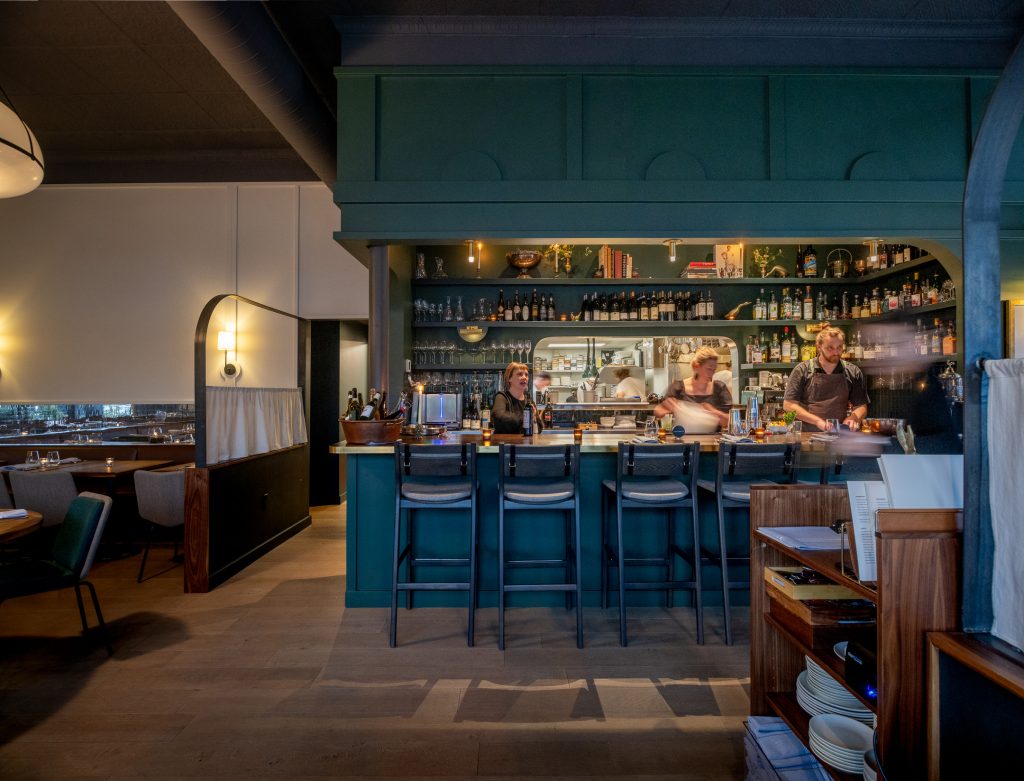
CDA’s vast hospitality portfolio, which spans award-winning names like Vinai, Bûcheron, Diane’s Place, and Kado No Mise, is a tangible reflection of this shift—offering a master class in tasteful, controlled world building. Vinai’s Laotian mountain-inspired wooden gables and herringbone tile backsplash may feel like a different language entirely from Bûcheron’s “French lumberjack,” pine-forward interiors, but both arrive at the same result: offering diners a fleeting escape from reality. If only until dessert.
“I think [since the pandemic] people are much more used to being at home or spending more time at home. So, having a chance to just feel different seems exciting,” says Harner. In terms of design trends, she has seen that desire for novelty translate into a gradual departure from minimalism. “On some of our early restaurant projects, the idea was to keep them very clean and bright, but I think things are trending in a more colorful, moody, textured direction.”

CDA’s recent work on 50th & France’s Noma Hi-Fi suggests no different—a neon-lit basement vinyl lounge that pulses with a moody, kinetic energy. Regardless of diners’ food preferences, the transportive atmosphere achieves a near-universal effect: a shift in energy; a break from the mundane; a glimpse of something new.
Local influencer Kim Ly Curry, who creates food-focused content for over 51,000 Instagram followers, has noticed this momentum in the dining scene, citing recent concepts like The Cabana Club and Boketto as spaces that draw the eye and engage the senses in interesting ways.
“People don’t want to be in a rut. We want something new—we want to be wowed. And especially with social media, people are so much more visual now,” Curry says.
In this oversaturated visual economy, restaurants are driven to behave almost like fashion brands—where one stylized photo or cinematic reel is enough to capture consumer attention. It’s easy to believe this when you stare up at dramatic spectacles like Stock & Bond’s 38-foot, gold-etched ceiling murals or Colita’s lush, plant-covered bar backdrop—an unspoken encouragement seems to hang in the air, almost whispering: Take the picture.
Looking ahead, Harner doesn’t see this type of immersive hospitality slowing down. CDA’s work on Americana is poised to assume many of these atmospheric identifiers all at once: spectacle, story, and escape.
“Daniel [Del Prado] came to us with this concept—it kind of parallels this post-pandemic era, actually—of Americans returning after World War II with a newfound exposure to Asian and Italian cuisine, which fueled a national popularity in tiki bars and classic Italian restaurants.”
The immersive concept will fill the former Barrio space on 50th & France, with plans to build out a glass-enclosed rooftop overlooking the district—a spectacle that feels strikingly novel within the venerable Edina neighborhood. Del Prado’s nostalgic storytelling will run through the design details, building a world that stretches far beyond dining. “We’re designing through the lens of that unique post-war American experience. Drawing on trends from the ‘50s but filtered in a new and modern way,” says Harner.
Whether or not you were “put on this earth to go out to dinner,” projects like Americana demonstrate an exciting new direction in dining, one where restaurants function more like cultural hubs than kitchens—as much for the artists, aesthetes, historians, and storytellers as for the foodies and oenophiles. As Minneapolis approaches its first MichelinGuide selections in 2027, perhaps food is only one brushstroke in a larger cultural portrait—one designed to challenge, inspire, and linger long after the last bite.
Eat Your Style Vibe
Whether you’re craving a European beach villa or a Roaring Twenties-style speakeasy, Twin Cities restaurants are increasingly crafting atmospheres that double as mini escapes. Choose your vibe and book your res.
The Maximalist Dinner Party: Boketto (St. Louis Park)
The French Mountain Lodge: Bûcheron (Minneapolis)
The Seaside European Escape: Vagabondo (Excelsior)
The Metropolitan Muse: Spoon & Stable (North Loop)
The Tropical Getaway: The Cabana Club (Northeast)
The Coastal-Chic Retreat: Martina (Linden Hills)
The Vintage Supper Club Revival: The Commodore (St. Paul)
The Grandma-Chic Embrace: Myriel (St. Paul)