

Photo by Julie Lyrek
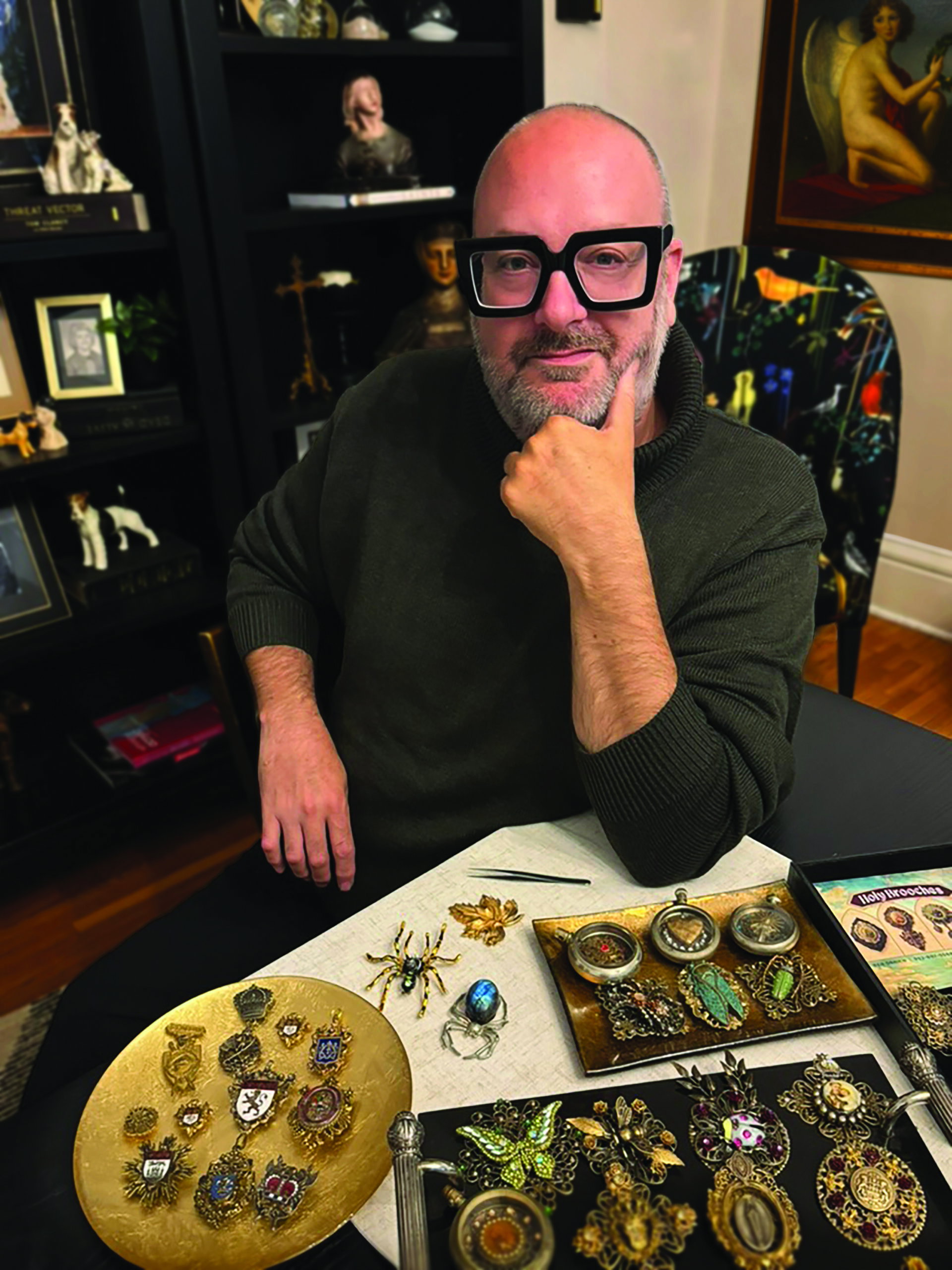
For Ken O’Brien, a flea market table covered in old jewelry, forgotten pendants, and vintage religious objects isn’t simply a collection of castoffs. It’s a collection of possible stories. But not everything makes the cut.
“When hunting, wherever I am, I have to see the story in it,” O’Brien says. “I don’t pick up every cross or pendant if I can’t see a story.”
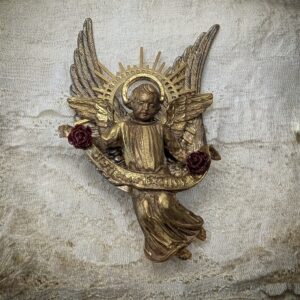
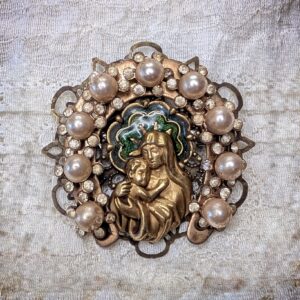
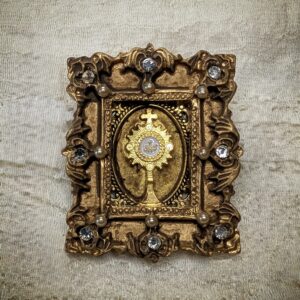
Those stories are at the heart of Holy Brooches, O’Brien’s emerging line of elaborate, one-of-a-kind wearable art. Created from vintage treasures and found objects, the pieces draw heavily on Catholic imagery, fashion, history, and O’Brien’s own childhood memories.
On Oct. 1, O’Brien will bring the collection to Twelve Vultures in Northeast Minneapolis for a trunk show from 4-8 p.m., where he’ll also debut a new collection inspired by bugs and insects.
A Divine Inspiration
Long before O’Brien began making brooches, he was absorbing the visual language that would eventually inspire them. Growing up in Duluth, he attended Holy Rosary Catholic Church and parochial school, where he was taught by nuns and served as an altar boy. He remembers being captivated by the church’s stained glass, rich colors, gleaming gold altar, rituals, and ornate architecture.
“Holy Rosary, unbeknownst to my grade school self, was the catalyst to all of this,” he says. “It was—and is—such a beautiful place of comfort and inspiration.”
Rather than treating that imagery with irony, O’Brien sees Holy Brooches as a celebration of the beauty and positive experiences he associates with his upbringing. “Sharing those memories with my friends and clients through my pieces is a blessing,” he says. “It’s the joyful essence of Holy Brooches.”
The Thrill of the Hunt
O’Brien searches estate sales, flea markets, antique shops, junk markets, and online sources for materials, but visual appeal is only the beginning. He wants an object to suggest something larger before he brings it home.
Once he starts creating, one object typically takes the lead. “I pick a hero piece and build around it,” he says. “I return to its origin story: Where did I find it? When? What is the piece saying?”
From there, O’Brien adds layers—trims, rhinestones, embellishments, and other flourishes—as the composition develops. The result is deliberately maximalist and impossible to duplicate. “Each piece is truly one of a kind,” he says.
Holy Brooches began about two years ago as an experiment encouraged by an artist friend. O’Brien made his public debut during Art-A-Whirl in 2026 at Rogue Buddha Gallery, followed by a trunk show at Combine in Uptown Minneapolis.
Brooches Are Back
O’Brien’s timing happens to coincide with renewed interest in a form of jewelry that lends itself particularly well to individual expression. He points to fashion houses including Schiaparelli, Chanel, Alexander McQueen, and Gucci as examples of designers using brooches in bold ways. At the same time, enthusiasm for thrifting, vintage fashion, and repurposing has opened up seemingly endless possibilities for styling them.
O’Brien is particularly interested in moving the brooch beyond its traditional spot on a lapel. “I love to use them in unexpected spots like shirt or pants cuffs, on a belt, or as many of them as possible all over the front of a jacket,” he says. “Brooches are here to stay!”
His own creations are certainly not designed to disappear into an outfit. “My intention is to create wearable art,” O’Brien says. “My customer is a person who covets statement pieces.” More than making a fashion statement, however, he hopes the wearer senses some of the history and emotion embedded in each piece. “Wearing my relics is an affirmation for your day, your life,” he adds.
What Comes Next
O’Brien is already looking beyond the imagery that launched Holy Brooches. He has begun exploring whether the concept might incorporate elements of Jewish tradition, while also creating nonreligious pieces—including the new bugs and insects making their debut at Twelve Vultures.
Another source of inspiration is considerably more regal: the heraldic imagery of Renaissance fairs. “The Tudor and Elizabethan crests and shields are such perfect pageantry jewelry,” he says. “I am eager to channel that revelry and attitude.”
For an artist whose work began with childhood memories of stained glass, incense, ritual, and spectacle, it seems a natural progression. Whatever direction Holy Brooches takes next, O’Brien will still be hunting for the same thing: an overlooked object with a story waiting to be worn.
IF YOU GO: Holy Brooches at Twelve Vultures; Oct. 1, 2026, 4-8 p.m.; 507 E. Hennepin Ave., Minneapolis