


One hundred years ago, the committee for the Pulitzer Prize for Literature at New York’s Columbia University selected “Arrowsmith,” the latest novel by Sauk Centre’s Sinclair Lewis, as its winner for 1926. “Arrowsmith” follows the ups and downs of a whip-smart young man who leaves his small town to pursue a medical career. In his pursuit of an examined life, the young doctor runs into a series of institutional and personal obstacles.

Courtesy of Wikicommons
“Sinclair Lewis knew about the crazed feeling that you get when people think you’re a pleasant person. You get all this praise for your good behavior, but inside you’re seething,” said fellow Minnesota literary giant Louise Erdrich in a 2010 interview with the Paris Review. That sense of seething below the surface was evident in Martin Arrowsmith, the title character of the novel, and would also become evident in Lewis himself, who led a strikingly fidgety life, both before and after he gained critical and commercial esteem as a writer.
That uneasiness came through in Lewis’ response to the Pulitzer committee. He shocked the literary world by turning down the prize. No one had done anything like this before. He explained his decision in an open letter to the committee.
“All prizes, like all titles, are dangerous,” Lewis wrote. He feared that “the appraisal of the novels shall be made not according to their actual literary merit but in obedience to whatever code of Good Form may chance to be popular at the moment,” he continued. The novelist recoiled from the idea that his work was currently fashionable rather than a work of enduring literary merit.
Many critics regarded Lewis’ letter as mere sophistry. They believed that he refused the award as a publicity stunt or as sour grapes for not winning for “Babbitt” or “Main Street,” two of his previous and more controversial works. Lewis gave ammunition to such critics in 1930 when he accepted the Nobel Prize for Literature, becoming the first American to receive the honor.
Lewis was no stranger to controversy. By the time “Arrowsmith” hit shelves in October 1925, Lewis was arguably the country’s premier polemicist. He spent the 1920s penning some of the most striking novels in American literature. Sinclair the satirist pilloried small town America in “Main Street”, businessmen in “Babbitt,” the Protestant clergy in “Elmer Gantry,” and the nation’s gentry in “Dodsworth.”
The acrid sense of humor that Lewis displayed in his work had its roots in the Minnesota prairie.
Harry Sinclair Lewis was born on Feb. 7, 1885, in Sauk Centre. Located in Stearns County, Sauk Centre is about 75 miles west of the Twin Cities. It serves as the model for Gopher Prairie, the setting for “Main Street” (1920), Lewis’ breakout novel. In the 1880 Census, Sauk Centre had 1,201 residents. In 2020, the Census Bureau put its population at 4,555.
“Harry,” as he was known as a child, was the youngest son of Dr. Edwin J. Lewis and Emma Kermott Lewis. He shared a bedroom with older brothers Fred and Claude, who were ten and seven years older than him, respectively. Harry’s mother was ill for the entirety of his early life, battling the tuberculosis which led to her death in 1891. Little Harry spent scant time with Emma, who spent most of those years in several different southwestern states seeking relief from her symptoms.
Sinclair Lewis’ father was a physician. He treated patients in the living room of their compact two-story home. His father was harsh and unsympathetic to the quiet and bookish boy. Lewis kept a diary starting at age 12 in which he detailed various indignities.
Harry was the runt of the litter. Peers described him as gangly and mocked him for his acne. His more robust older brothers, Fred and Claude, were apparently favored by their father, who didn’t think the physically and socially awkward Harry would make much of himself.
Older and thicker boys pounded on Harry and he had few friends.
His closest familial confidant appears to have been his stepmother, Isabel Warner, who married Edwin in 1892.
The young diarist turned published/writer at an early age. He wrote for school publications and penned several stories as an adolescent for his hometown newspaper, the Sauk Centre Herald.
Edwin died in 1926, not long after Sinclair was awarded the Pulitzer Prize. For much of Sinclair’s adult life, his father was angry at him for the way he portrayed his hometown in his work. On several occasions, major characters in Lewis’ novels were physicians, including in the prize-winning “Arrowsmith.”
Sinclair Lewis had been a fantastic student and aspired to attend Yale University. He left home at 17 to spend a year at Oberlin Academy in Ohio, a preparatory school at Oberlin College known for its rigorous coursework. Lewis excelled enough at Oberlin to earn admission to Yale. Lewis had not been raised in an especially religious home and found Oberlin’s thoroughly Presbyterian environment stifling. He developed a lifelong aversion to organized religion at the school.
Lewis matriculated at Yale in 1903, where he seemed only marginally happier. He succeeded academically and found outlets for his writing in the school’s various publications. While at Yale, he had several pieces of poetry and prose published in the college’s magazines. Yet, Sinclair struggled socially and never felt at home in New Haven. Lewis was described by peers as either shy or smug. His provincial manners led to the perception that he was the country cousin.
He departed Yale for a time to work at author Upton Sinclair’s literary commune in Englewood, New Jersey. Lewis returned to Yale in 1907 and completed his bachelor’s degree in 1908 before hitting the road.
He worked briefly for a newspaper in Iowa before heading to the west coast, where he befriended Jack London, an early supporter of Lewis’ work. He worked for a time in New York publishing houses and became a part of the city’s literati.
Sinclair Lewis, as his byline appeared, started to make a good living writing short stories for the likes of the Saturday Evening Post while trying his hand as a novelist. Lewis published a series of novels during the 1910s, none of which were breakout hits.
In 1914, he married Vogue editor Grace Hegger. The couple had a son named Wells, who was born three years later. Lewis saw his son infrequently and was estranged from him for significant stretches of time. Wells served as an officer in the United States Army during World War II. The young lieutenant was killed in action in France in October 1944.
For his seventh novel, Lewis turned the lens back to his hometown, fictionalizing Sauk Centre under the name Gopher Prairie in “Main Street,” which was published in October 1920.
Main Street’s central character, Carol Kennicott, is new to town, an educated transplant who married a local doctor. She aspires to remake Gopher Prairie in the image of the region’s metropolises, namely Chicago and the Twins Cities, but her efforts are in vain. The provincial burg remained the provincial burg despite her best efforts.
The imperious Carol aspires to uplift the podunks of Gopher Prairie to her level but fails at every turn. She finds herself isolated in the village and dismissed by the community’s crass cognoscenti of club women and men.
After nearly two decades as a professional writer, Lewis became an overnight success when “Main Street” hit it big. The book sold more than 2 million copies during the 1920s and may have been the decade’s most successful work of American fiction.
“Main Street” was controversial but not as much as one might imagine. A smattering of libraries in Minnesota banned the book but not Sauk Centre, which seemed open from an early date to making him a favorite son. One hundred years later, Sinclair Lewis is anything but controversial in his hometown
“I don’t think anybody thinks about that anymore. I think there were feelings at the time, but the community as a whole got over them,” said Marilyn Klaphake, curator of the Sauk Centre Area History Museum, which began managing the Sinclair Lewis Boyhood Home, also located in Sauk Centre, on Aug. 1.

Courtesy of Wikicommons
“Locally, everything is named after him in the town,” Klaphake said. “We have Sinclair Lewis Avenue, the original Main Street, every other business in town is Main Street Realty or Main Street Tile. Babbitt’s Wine Bar. Arrowsmith Apartments,” she continued. Heck, Sauk Centre High School’s athletic teams have played under the moniker “Mainstreeters” since the 1920s!
Klaphake asserts that any poking that Lewis made in the direction of Sauk Centre is far in the rearview mirror. “He wrote about medicine and business and rural life in general. He lampooned everybody. It’s not just the good citizens of Gopher Prairie in ‘Main Street’ that saw his fighting words,” Klaphake said.
Lewis got much harsher in his next novel, “Babbitt” (1922). Set in the small city of Zenith, “Babbitt” satirized the ballyhoo of American businessmen and civic boosterism.
“Babbitt” (1922) delves into the vacuousness that Lewis witnessed among American businessmen during the 1920s. He saw them as uncurious philistines who conformed to Rotarian social pressure rather than thinking for themselves. The main character, George F. Babbitt, is a boorish, bigoted social climber who is easily enchanted by new trinkets and swills liquor in private but virtue signals in public by supporting prohibition. A prisoner to convention, Babbitt, at a certain point, comes to see newfangled ideas as fashionable. Suddenly, he embraces bohemianism, socialism, and seeks out the companionship of flappers. Eventually, Babbitt returns to his more conventional form of conformity. Readers are left realizing that the man was an empty suit with few real opinions of his own. “Babbitry” came into the lexicon as a descriptor for the banal conformism of the business class
Scribes in virtually every sizable Midwestern city laid claim to being the inspiration for Zenith, but Lewis himself wrote that it was just a stand-in for any mid-size city in the region. Apparently, both “Babbitt” and “Main Street” received strong consideration for the Pulitzer Prize, the leading award in American literature, but it was his less combative follow-up that finally won the pony.
Harcourt, Brace & Co. published “Arrowsmith” in March 1925. Title character Martin Arrowsmith rises in the world from his hometown of Elk Mills, located in Winnemac, the same state as Zenith. He moves to New York and becomes a hot-shot doctor and researcher before returning to private practice in the heartland. A series of ill-fated amours led him back to his native Midwest. Arrowsmith has a strong will to power and comes into conflict with every boss or mentor he encounters. Eventually, he returns to the east and a prestigious research institute. He discovers a cure for a plague currently ravaging the Caribbean. Arrowsmith wishes to keep testing his treatment in scientific trials but is persuaded to treat the locals once everyone else in his research party dies. He regards his decision as a betrayal of scientific principle.
After curing the islanders, Arrowsmith is offered directorship of a major medical institute. He turns them down to pursue his own research ends. In a conclusion that eerily foreshadowed the author’s own life, Arrowsmith abandons his family and moves to the backwoods of Vermont to focus on his research.
Arrowsmith is a veritable theme fest which offers insights into many twenty-first century matters. Readers witness the conflict between the mandates of research and the desire to help people in the here and now; whether private shortcomings should figure into the perception of public figures; professional jealousy and greed are the coins of the realm; one sees the often-perverse dynamics of institutions; the commercial interests of pharmaceutical makers versus the imperative to help; and the pursuit of professional goals at the cost of personal relationships and responsibilities.
After winning the Pulitzer, “Arrowsmith” would be adapted into a 1931 film starring Ronald Colman and Helen Hayes. It was a box office hit and received significant critical acclaim, including four Academy Award nominations.
After riling people up by turning down the Pulitzer, Lewis ramped things up further with his next novel, “Elmer Gantry” (1927), one of the most searing critiques of clerical charlatanism ever written.
The main character Gantry fancies himself to be the cock-of-the-walk. He attends seminary but gets kicked out for boozing and womanizing. He finds his true calling as a Babbitt-esque traveling salesman but winds his way back to the ministry after taking up with a traveling evangelist named Sharon Falconer, who was almost certainly modeled on Aimee Semple MacPherson, who was to radio what Jimmy Swaggart would be decades later to television. Gantry excels at fire and brimstone preaching, bringing dollars and followers into the church all the while raising hell on the side. After Falconer dies in a fire, Gantry strikes out on his own, upping the ante on his scorching rhetoric and personal appetites. Eventually, Gantry’s vices catch up with him.
Lewis researched the novel by attending multiple church services every Sunday while residing in Kansas City.
“Elmer Gantry” was a major commercial and critical hit at the time of its release, earning ever more public notoriety based on all of the denunciations it received from ministers across the country. The more communities that banned the book or clergy that called for Lewis’ head, the more popular the book became.
Decades later, the 1960 film version was a massive hit as well, earning Burt Lancaster an Academy Award in the title role while Shirley Jones won Best Supporting Actress for her portrayal of Lulu Bains.
After a decade of exceptional work, the Nobel Committee awarded Lewis its prize for literature (1930), making him the first person from the New World to win the honor.
In his Nobel address, Lewis said that American writers and readers alike feared works which did not glorify all things American, a sentiment which could clearly not be said of his work.
After the flurry of writing that brought Lewis global literary acclaim and great fortune, the last two decades of his life could charitably be characterized as restless.
He struggled with substance abuse, namely alcohol abuse, for years. He did several stints in treatment facilities.
In early 1928, Lewis took up with noted newspaper scribe Dorothy Thompson after meeting her in Berlin, Germany. He divorced his wife and married Thompson that Spring. They purchased a home in Vermont and had a son named Michael. The marriage soured quickly and was noteworthy for its acrimony. Lewis left his family in Vermont and pursued other professional interests. After a number of years apart, Lewis and Thompson finally divorced in 1942.
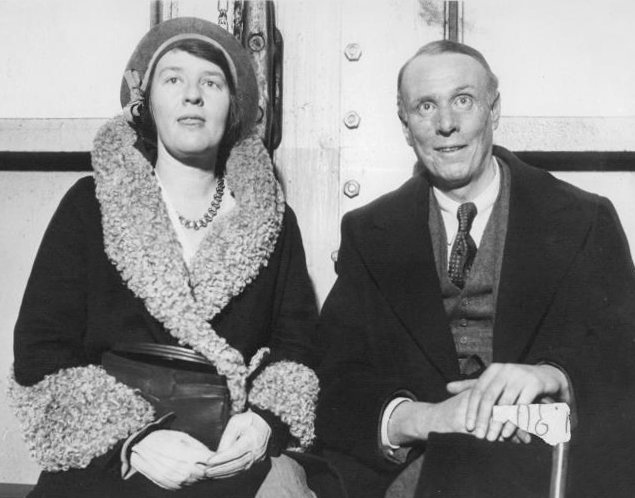
Courtesy of Wikicommons
Lewis kept writing. He wrote a few less acclaimed novels, a couple of Broadway plays, and penned a weekly column for Newsweek.
He taught creative writing briefly at the University of Wisconsin in Madison before leaving abruptly in the middle of the fall 1940 semester. He lived for a time in rural Williamstown, Massachusetts, and fancied himself a gentleman farmer, but that didn’t last.
In late 1950, Lewis was hospitalized in Rome, Italy, for acute alcohol withdrawal. He died on Jan. 10, 1951, in Rome after suffering a series of heart attacks. A week later, Lewis was buried in the Greenwood Cemetery in Sauk Centre.
The one work from his later years that has earned a reputation comparable to his 1920s novels is “It Can’t Happen Here” (1935). The satirical novel focuses on the election of a fascist as President of the United States. Written in the authoritarian age of Hitler, Stalin, and Mussolini, many readers have taken a new interest in the book in recent years, finding parallels to the administrations of Donald Trump.
Klaphake says that residents and visitors alike remain interested in Lewis and his legacy. A steady stream of visitors come to Lewis’ beautifully maintained boyhood home in Sauk Centre. That doesn’t make his work an easy read though.
“I think people locally find reading his books a little bit difficult. We’ve tried reading some of the books, and I think they have to realize at the time was so different and his writing is so different than with people at that time were used to. He was a new style of artist. You have to set yourself back into that time. When life was amazingly different,” Klaphake said.
Readers willing to embrace works written in a very different time will find great insights and enjoyment in Lewis’ novels. Despite the author’s personal struggles and shortcomings, his work speaks for itself just as much as it did 100 years ago.