

Courtesy of Wikicommons
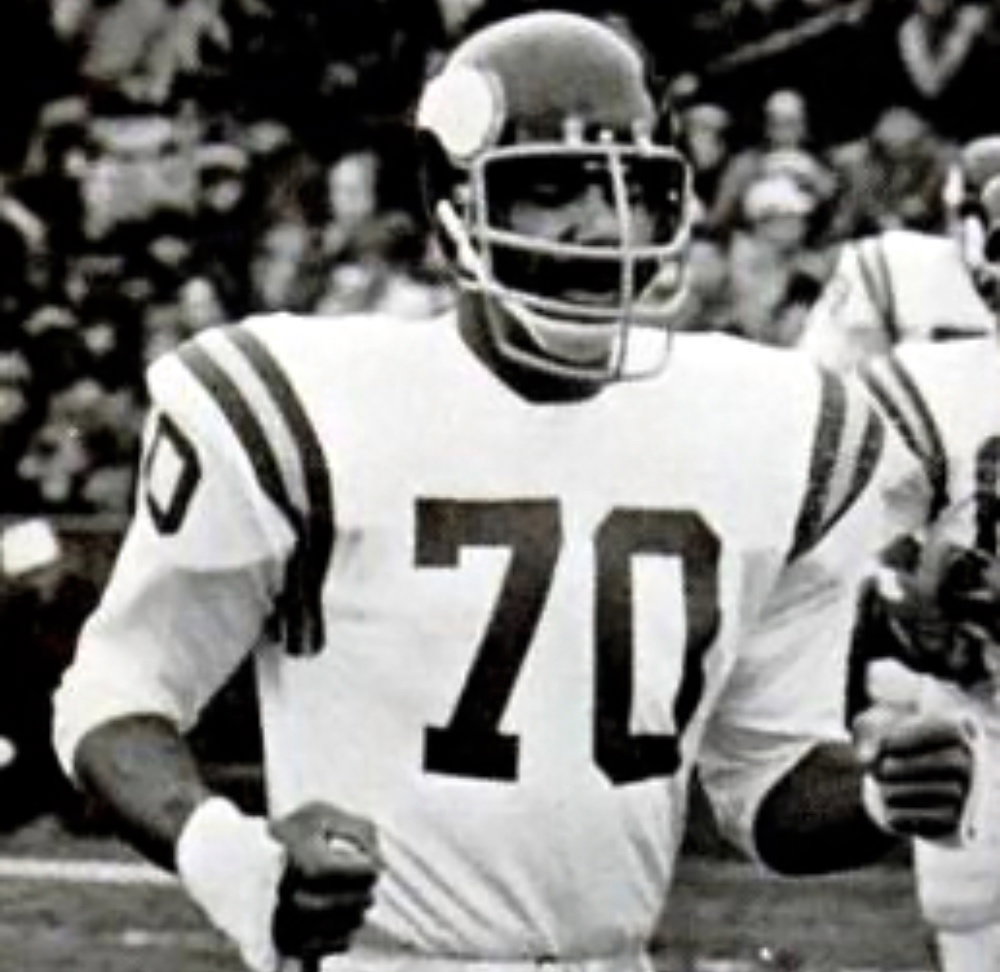
Jim Marshall isn’t in the Pro Football Hall of Fame, but he ought to be. One of the National Football League’s best defensive linemen of the 1960s and 1970s, he served as an anchor on the front line of Minnesota’s feared “Purple People Eaters” for 19 seasons.
While Marshall may never receive a bust in Canton, Ohio, home of the Pro Football Hall of Fame, he carved a legacy all his own during his time in Minnesota, both on and off the field. Marshall might have been the most indestructible human being that ever lived. His peers aren’t gridiron heroes. They’re folk heroes. Jim Marshall is more like Paul Bunyan or Big Honza than he is Joe Montana.
As a football player, Marshall was the NFL’s Iron Man. For decades, he held the league’s record for most consecutive games played (282) and most consecutive games started (270). A generation later, both records were broken. In the case of the consecutive games started streak, it was then-Minnesota Vikings quarterback Brett Favre who surpassed Marshall.
It is hard to imagine that Marshall’s mark for death-defying experiences will ever be matched. The man survived gunshots, comas, crashes on land, sea, and air, and getting stranded in Yellowstone National Park during a blizzard. Most of these events took place before Marshall even retired from the NFL at age 41.
James Lawrence Marshall was born in 1937 in central Kentucky but spent most of his childhood in Columbus, Ohio. He was a good student and a great athlete, earning All-State football honors at Columbus East High School and drawing interest from a wide range of college scouts.
He also got himself into a lot of trouble. As a teenager, he stole and resold hubcaps while moonlighting as a bookmaker. Marshall said that many of his adolescent running mates in Columbus spent much of their lives in prison.
Marshall played college football in his hometown for the Ohio State Buckeyes while earning good grades as a biology major. As a junior, he was a consensus All-American at defensive end (1958). Decades before it became commonplace, Marshall left school a year early to play professional football but not in the NFL or its soon-to-be rival, the American Football League. Marshall started his professional career north of the border with the Saskatchewan Roughriders of the Canadian Football League. After a stellar CFL rookie season in 1959, Marshall joined the NFL’s Cleveland Browns.
He enjoyed a solid, if unspectacular first season in the NFL in 1960 but certainly made a name for himself off the field. During training camp, he choked on a grape and nearly died. Apparently, he took up archery during this time as well. He made a game of shooting arrows as high as he could—a dangerous proposition to anyone familiar with gravity.
Marshall was already known to be a gun enthusiast. He carried a pistol and large amounts of cash on his person at all times.
Marshall was drafted into the US Army and spent the offseason in 1961 completing his military service. During that time, Marshall contracted encephalitis from a mosquito bite. He spent time in a medically induced coma and lost 50 pounds. Three weeks before the start of the 1961 season, Cleveland sent Marshall to the expansion Minnesota Vikings as part of a multi-player deal.
Marshall would start at defensive end in the fledgling Vikings’ first regular season game on September 17, 1961. He would go on to play in every single Vikings game of the 1960s and the 1970s.
Courtesy of Wikicommons
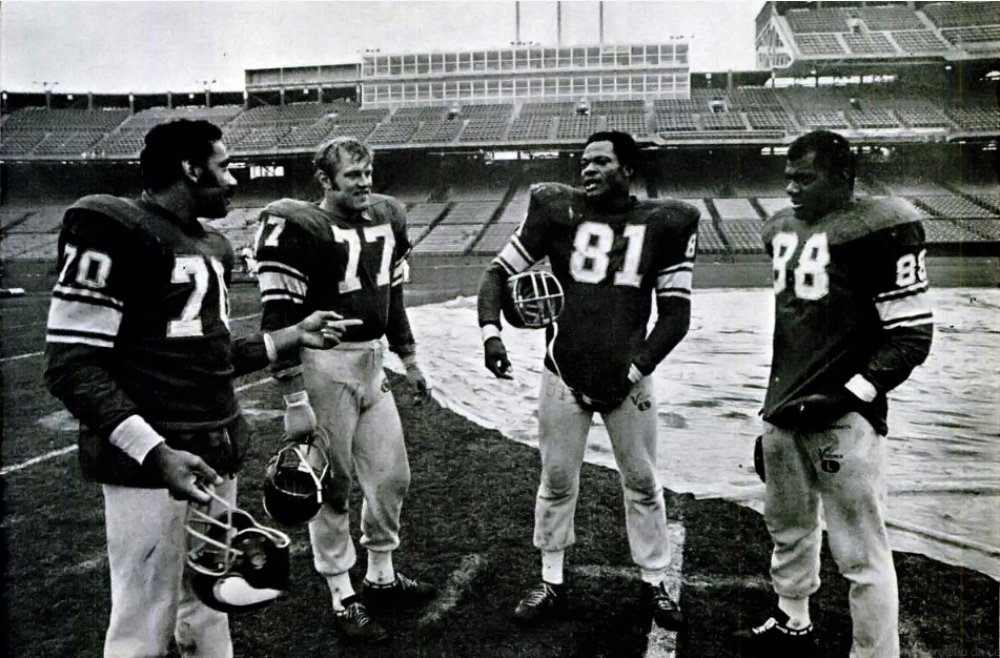
It didn’t take long for Marshall and his comrades on the defensive line to assert themselves as one of the league’s finest units. Known as the “Purple People Eaters,” Marshall, Carl Eller, Alan Page, and Gary Larsen ravaged opposing offenses throughout the 1960s and 1970s. Page and Eller received the most acclaim, earning nine and six Pro Bowl selections respectively. Both men are in the Pro Football Hall of Fame. Marshall and Larsen were highly regarded as well, both earning two Pro Bowl bids.
Marshall was what 21st century sports commentators call a “glue guy.” He was the one hauling ass every day in practice, encouraging his teammates to do the same. He led calisthenics with gusto. During games, Marshall was often the guy who attacked double teams from the offensive line to free up the likes of Eller and Page. His playing weight was around 220 pounds, often 50 pounds lighter than the man, or men, trying to block him.
Vikings coach and Pro Football Hall of Famer Bud Grant said the Vikings would not have had nearly the amount of success they did in the 1960s and 1970s without Marshall.
As a player, Marshall may be best remembered for his “wrong way” play during the 1964 season. On October 25, 1964, Marshall recovered a San Francisco 49ers fumble and started heading toward his own endzone. Sixty-six yards later, Marshall crossed his own goal line and threw the ball up in the air to celebrate. The ball went out of the end zone and the play ended up as a 49ers safety. He only realized what had happened when a 49ers player came up to him and thanked him. At -66 yards, it remains the biggest loss on a single play in NFL history and is a fixture of NFL highlight reels to this day.
But Marshall’s legacy should be more than that miscue. Marshall served as the Vikings captain for 14 seasons, longer than any player in the history of the franchise, played in all four Vikings Super Bowl appearances, and the franchise retired his number 70. He also holds an NFL career record with 30 fumble recoveries.
After Marshall’s final home game in Minnesota, the typically stoic Grant got tearful and awarded Marshall the game ball. It was the first time that Grant had ever awarded one. At the time of his retirement, Marshall had played in every single game in Vikings history.
Amid his “Iron Man” career, Marshall posted some off the field statistics that made even his on-field accomplishments seem tame.
During the 1964 season, he started the week in the hospital and ended it on the playing field on three different occasions. First, he was hospitalized with pneumonia. Then, he spent the night before a home game in the hospital with ulcers. In what sounds like a professional wrestling storyline, an ambulance dropped him off at Bloomington’s Metropolitan Stadium just in time for kickoff.
The wildest Jim Marshall incident that season came when he accidentally shot himself. Marshall was cleaning one of his shotguns and accidentally pulled the trigger. He ended up with buckshot in his stomach and a third stint in the hospital in a matter of weeks.
Jim Marshall’s 1964 was more a microcosm of the man than an aberration.
His tamer off-season pursuits included hang gliding, sky diving, and scuba diving. Marshall was a sky diving enthusiast, having completed more than 2,000 lifetime jumps. As a point of comparison, a graduate of the US Army’s Air Borne School at Fort Benning, Georgia receives their Master Parachutist Badge after completing 65 jumps.
Marshall was known as the fastest beer drinker in Vikings camp, taking down whole bottles in mere seconds.
Marshall liked to drive fast in his cars and in his boats, leading to several accidents. On the day of a home preseason game, Marshall’s Mercedes-Benz made it back to Bloomington’s Metropolitan Stadium from training camp, eighty miles away in Mankato, before the occupants of a chartered plane.
The scariest incident of Marshall’s career came in January 1971, not long after the end of the previous NFL season. Marshall was part of a group of 16 people, primarily from the Twin Cities, who set out on a snowmobiling trek through Yellowstone National Park in Montana and Wyoming. The group included a number of well-known people such as Marshall’s Vikings teammate Paul Dickson, Minneapolis Star reporter Jim Kloubuchar (Senator Amy Kloubuchar’s father), and Hugh Galusha, president of the Minneapolis Federal Reserve Bank.
During the first leg of the journey, the snowmobilers got caught in a blizzard which rendered their machines inoperable. The conditions broke the 16 snowmobilers into four separate groups. Marshall’s party, which included his teammate Dickson, trudged through waist-high snow through the daylight. As darkness approached, Marshall’s group camped near a cluster of trees protected by a hill. Dickson had a lighter and started a fire. The party burned whatever they had to generate heat, including the bark from nearby trees and the wads of cash that Marshall carried with him. After another day on foot, rescue crews found Marshall and company before they had to spend another night in the cold.
One of the 16 snowmobilers did not make it home. Galusha, who found himself in one of the other groups, died from exposure.
Jim Marshall’s death-defying ways did not end with his retirement from the NFL in 1979.
In 1980, Marshall nearly died in a hang glider accident in Bloomington. The recently retired Viking crashed into a light pole. Marshall broke his leg and arm, collapsed a lung, received cuts all over his torso, and shattered a vertebra.
Thankfully, this incident proved to be an aberration during Marshall’s retirement. That didn’t mean that he had any less energy, especially when it came to helping others.
Marshall visited dozens of countries around the world and served as a popular keynote speaker for decades after his retirement from the NFL. He spent much of his retirement working to mentor children in the Twin Cities region, particularly those with similarly tough upbringings to his own. To learn about the problem of homelessness in Minneapolis, he lived for a time on the city’s streets. For much of his retirement, he resided in St. Louis Park.
After a long illness, Marshall died in Minneapolis on June 3, 2025, at the age of 87. While he never made it to the Pro Football Hall of Fame during his lifetime, he has appeared near the top of lists of “Best Players Not in the Hall of Fame” for decades. In 2023 and 2024, he was a semi-finalist for the Hall of Fame but did not achieve enough votes to reach the final round of voting. Nevertheless, the story of Jim Marshall remains essential to telling the story of the National Football League generally and the Minnesota Vikings specifically. For Minnesotans, he was a living, breathing Tall Tale who persisted through remarkable circumstances.