

I could barely take another step. Hands on my knees and panting for breath, I smiled at my wife and told her we had finally reached our destination. We were standing at the top of Whitewater State Park’s Coyote Point in southern Minnesota, looking out over a river valley surrounded by oak trees. Wiping sweat from my brow but happy to be out in the wild, I stared at a map on my iPhone—a tiny red dot showed the location of what was essentially buried treasure.
“Right around here somewhere,” I said, stepping onto a dirt trail and looking around. A few tree branches snapped under my feet. Slightly confused, I finally noticed the geocache container hidden in a place I would not have expected (and won’t reveal because it spoils the surprise). Inside, I found a few trinkets, personal notes, instructions, a pencil, and a logbook.
That’s when I realized: I had fallen in love with an activity called geocaching. It was well worth the 300-step climb from the parking lot, the long hike in the woods, and the three-hour drive from our home on the west side of Minneapolis. Standing next to a massive outcropping, I felt an overwhelming sense of peace—a respite from the frantic pace of modern life. I signed my name in the logbook and stashed the geocache for the next explorer to find.
The Basics
The concept of geocaching is quite simple—it’s like looking for a buried treasure. You use a handheld GPS from a company like Garmin or a geocaching app on your phone. After looking up the coordinates, you move to that exact location—X marks the spot. A geocache usually consists of a few small items, some coins, a logbook, and other trinkets in a box or a jar.
Since 2000, over 1.2 billion geocaches were logged worldwide. Interest has blossomed even more since COVID, when people rediscovered the hobby. In 2024, 88.5 million geocaches were logged in the U.S., but that number jumped up to 111 million last year.
There are 28,000 geocaches scattered all over Minnesota, tucked away near riverbeds, stashed in tree stumps, and buried next to wooden fences. While the Minnesota DNR wrapped up its official geocaching program about five years ago, several parks still place official geocaches near campgrounds and visitor centers. In late April, we started geocaching because we wanted to get away from the hustle and bustle of city life and rekindle our love for nature. Our goal was to find out if the hobby is still a vibrant activity in the state and worth the effort. It was also an excuse to go hiking and visit a couple of state parks, slow down a little, and breathe.
Bluffside Hunting
We started in Winona, population 26,000, about two hours southwest of the Twin Cities. Even though my wife, Rebecca, and I have been married for 38 years and raised our kids in the state, we’d never visited this city in the Bluff Country—once called the Miami of Minnesota. (Using that phrase is a bit ridiculous, but the two cities are in similar southwest locations in each state. Also worth noting: The temp was 10 degrees warmer than Minneapolis the day we visited.)
My first surprise was that the route down to Winona is so spectacular—massive outcroppings, glorious sun-kissed hills, and the Mississippi River widening into Lake Pepin. We felt our stress slowly subside the further we drove along the river. Because the Mississippi is so wide along Highway 61, it looks more like one incredibly long lake.
We arrived in Winona just as the Blooming Grounds coffee shop downtown was opening and started to plan our adventure, coffee cups in hand. The shop serves wonderful scones and other baked goods, and I’d heard their breakfast sandwiches were quite tasty. I pulled up the Geocaching app on my iPhone and looked for a cache. There were several at the top of Sugar Loaf Bluff, which sits high above Winona. These were virtual waypoints—basically, GPS coordinates that you find to answer a few questions, but without a physical cache.
Good enough for us, I thought. We drove to the base of the cliff and started our climb. It was one of four times during the day that we hiked high above the city. After locating each waypoint, we met a couple visiting from Rochester and chatted all the way back to our cars. They told us about a donut shop called Bloedow Bakery where people stand in line all morning, wrapped halfway around the block. “In Winona?” I asked Rebecca with a chuckle. “That seems like something you’d find in Uptown. We need to find out what all the fuss is about.”
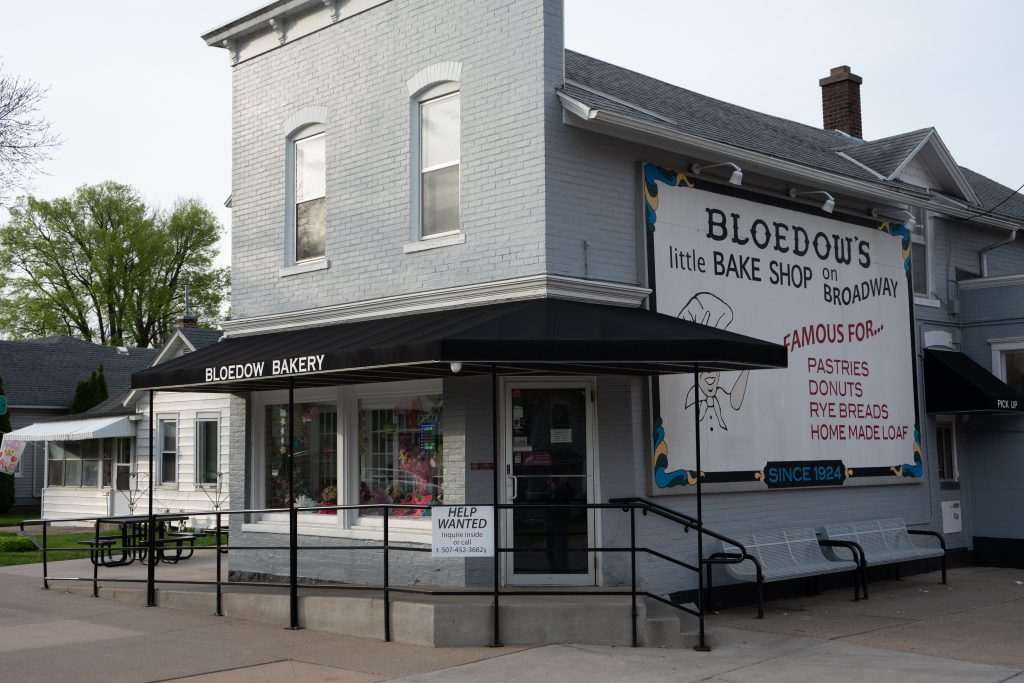
The bakery opened way back in 1925. Owners Hugh and Mary Polus serve bacon-wrapped maple donuts, cookies, and other pastries. Sure enough, when we arrived, there were about a dozen people waiting in line. You have to order fast! Their glazed donut is the best I’ve ever tasted, hands down (and a little sticky). Fueled up and ready for more exploration, I opened the geocaching app again and found coordinates for a cache near Garvin Heights City Park, which is also up in the hills. “I think they are trying to give us a workout,” I joked as we arrived.
This is the point in the story where things started to get a bit dicey. After hunting around for about two hours, still enjoying the warm weather and bright sunshine, we couldn’t find the geocache. The truth is, no single entity runs every geocache. It’s a reliable hobby, but anyone can steal a cache or even log an entry without actually placing anything in that location. My attitude shifted a little—geocaching is a cat-and-mouse game, and the results are not always predictable. If you bring kids, be sure to explain that the buried treasures might not hold trinkets or coins. They might not even exist.
Feeling slightly bummed and dizzy from the donuts, we decided to go on a different type of hunt, this time for lunch. We drove back downtown and regrouped at Cafe Sapori di Sicilia, a trendy bistro serving delicious sandwiches and artisan breads. We were greeted by the friendly staff and more pastries but picked a fish sandwich instead (pleased at the reasonable prices).
Refreshed, we headed to Whitewater State Park—now with a renewed spirit. The park’s official geocache course is essentially a series of riddles that serves as an educational exercise—fun for kids because it’s all in close proximity.

Park ranger Jeremy Darst told me they run an official program year-round. “The course structure is set up so the clues can be found in any order. The target age is 10 and above, but younger kids can easily do it with an adult to help provide guidance. There are several clues that must be found and small riddles at each clue location.”
I used my phone to find two more obscure caches at the park. The Coyote Point cache is the best one I’ve ever found in the state. The climb is intense, but well worth the effort.
That predictability is important. I prefer state park geocaching because there are fewer distractions, no cars out in the woods, and the caches are more legitimate and well maintained. We climbed another staircase up to Inspiration Point, huffing and puffing all over again, and looked below to spot a gently flowing trout stream. I won’t reveal too many details, but that cache was also hard to find—we had to use the geocaching app for a few hints.
By evening, we were spent. After driving back to Winona, we visited The Old Tiger, which opened near the river in May, for dinner. We dined on burgers and a savory rice dish, noticing how the polite servers were still learning the ropes. A custom-made Arnold Palmer was one of the best I’ve ever had. “If you’re coming from the Twin Cities, it’s a beautiful river route here, especially if you take the train,” says owner Zoa Ryan. “Winona is historically so walkable with beautiful architecture.” The restaurant is in a historic railroad freight house and named after the first locomotive in the area.
That night, we stayed at a new riverfront hotel called Hotel 44° North, across the street from The Old Tiger. The property has 76 standard rooms and 24 extended-stay rooms. Rates start at $179 per night. “Winona has the second tallest ice-climbing wall in North America,” says owner Dan Rivers about why people come to the area year-round. “They light up the ice with lights. I’ve heard the tallest ice wall is in a gravel pit, so our views are much better.”
I soaked in the amazing view of the river and counted my blessings: We had tackled four climbs up the Winona hills, found multiple geocaches, and enjoyed our time together chatting about our adult kids. The next morning, we ate breakfast in the lounge—complete with assorted fruits, granola, scrambled eggs, and French toast sticks—and headed home.
Lakeside Waypoints
A few days later, we heard the call of the Great North and hit the road again, this time to Alexandria. Having lived in Fergus Falls for many years, we were already familiar with the city, population 14,000, but geocaching opened up a whole new world of possibilities.
We first made a beeline downtown and visited a restaurant called Longtrees. We were there just before it opened in May, and the restaurant already radiated supper club vibes, even amid the dust and construction. It’s located in a new downtown area called The Rune that sits on the north side of town close to Lake Agnes. There was no food to sample yet, but I could tell the owners, Abby and Mike Rakun, who have started multiple restaurants, were excited to make their Alex debut.
“Alexandria has the full package of sightseeing and shopping with all of the ambiance of a small town,” says Abby. She loves Lake Carlos State Park, where we planned to visit next, and she joked about how she once lost a camera there. Longtrees does local sourcing and makes their food from scratch, with nods to Scandinavia with lefse and other cultural dishes. “There’s a local vegetable farmer up the road whom I bought a dog from and got to know his whole family,” joked Mike.

Another brand-new establishment, called Little Round Still, opened in May, located in the same building across the hallway. Both foodie hangouts have a patio and are set on revitalizing the Alexandria downtown district. The distillery serves bougie drinks like gin and coke—delightful cocktails for discerning customers. On the walls, they use sheets of plated steel that once fell off a semi-truck on I-94. Owned by brother-and-sister duo Michael Stormoen and Melissa Polovick, the distillery was originally started by their dad in Wadena.
Enlivened by Alexandria’s downtown makeover and ready to start another geocaching adventure, we headed to Lake Carlos State Park, located just a few miles north of the city. On the way, we passed Carlos Creek Winery and made an impromptu plan to stop there after our excursion. Right away, I could tell Lake Carlos took geocaching seriously. There were instructions right at the kiosk, and the park ranger, Benjamin Eckhoff, is diligent about his program. “We ran nine programs last year with an average attendance of 14 participants each,” he says.
I found multiple geocaches scattered around the campground and near the visitor center. One of the geocache courses is for kids—you can borrow a handheld GPS for free from the ranger station, then start hunting for the coordinates. I found a small owl figure hidden in the grass with a tag, then found a second cache that was part of a word scramble puzzle.

Holding that small figurine made me think of the alternatives. Kids on their phones, playing video games and watching Nickelodeon. None of those activities are harmful on their own; it’s the consumption that worries me—the endless hours of video entertainment. Geocaching is a way to kindle a love for nature, to enlighten your senses. In science, there’s a concept called sensory dynamism. It means we need visual variance. When you look at a nature scene, you see the foreground grass, the trees off in the distance—it helps kindle the imagination.
Everything that has value takes time: friendship, love, relationships. Geocaching is the opposite of instant gratification. It’s slow gratification, the kind that builds inch by inch over time. My wife Rebecca said it best: We’ve lost touch with the slowness of life. Breathe in, breathe out. Feel the wind on your face, the warmth of the sun. As I walked past the Lake Carlos visitor center, I held one of the animal figures in my hand and raised it up to the sunset. Just then, the rays split through a few tree branches and I snapped a photo, an explosion of bright yellow.
Later that night, we decamped to Carlos Creek Winery and ate dinner at one of the restaurants there called Stoke Pizza, laughing about the steps in Winona, the geocache we couldn’t find, and the donut shop with the long line. We headed to an Airbnb called Grain Bins at Gathered Oaks just a few miles away; rates run as low as $125 per night. We slept in a reconditioned grain bin on a soft, pillowy bed, overlooking a private lake. When will that ever happen again in our lifetimes? Gathered Oaks is also a major wedding venue.

Falling asleep, listening to the loons and the whispering winds, we joked about Abby, the Longtrees co-owner, who asked us to find her camera at Lake Carlos, lost somewhere in the woods since 1995. I mentioned how we couldn’t find a geocache at the regional park in Winona, but it was still a blast. What else did we really find? A purpose. Meaning and significance. A clear goal. We set aside the labors of life to discover the hidden secrets of nature.
Geocaching, as a hobby, has a lot of competition. Maybe it’s the latest show on Netflix, playing Mario Kart on the Nintendo Switch, going to a summer blockbuster in a dark theater, or, worse yet, doomscrolling through TikTok videos. For us, this outdoor hobby is a way to turn off our devices, set a waypoint for a remote destination, and rediscover the world—one geocache at a time.