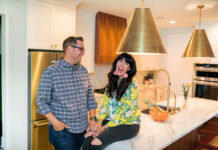


“It’s now time to discuss our traditional dessert—small, refreshing ice cream sundaes,” says Richard Grabow, innkeeper at Winona’s Alexander Mansion. I’ve just finished three breakfast courses, and the sundae is icing on the cake, so to speak.
The 1886 Victorian gem, its warmhearted innkeeper, and the unexpected sundae represent the charms you’ll uncover while road-tripping through southeast Minnesota. After tracing the Mississippi River south from the Twin Cities to Winona, I head west through the tiny villages along the Root River State Trail, Amish Country, Austin, and Rochester—discovering friendliness, history, and offbeat attractions at every turn.

Photo by Paul Vincent/Explore Minnesota
Museums
Take Ed’s Museum in Wykoff, a village of just over 400 residents. Edwin Julius Krueger, proprietor of the former Jack Sprat Food Store, spent his life collecting just about everything—and filled all three floors with treasures. Today, shelves remain stocked with original merchandise, photos of Hollywood stars cover the walls, dozens of player-piano rolls fill a bookcase, and decades of mail and magazines sit exactly as they were when Krueger died in 1989. He left the store to the town on the condition that it become a museum.
In Winona, the Kashubian Cultural Institute and Polish Museum offers a passionate, detail-rich tour led by volunteer Tim Breza, who shares the stories of Polish immigrants who settled in the city. Exhibits showcase art, crafts, photos, and original artifacts—including the Solidarity banner that flew over the Gdansk shipyards during the 1980 uprising, signed by world leaders.
Just a block away is the Watkins Heritage Museum, celebrating the founding of the J.R. Watkins Co. in 1868. From spices and dip mixes to its famous vanilla, Watkins products fill the on-site gift shop.
My next Winona stop is the Minnesota Marine Art Museum (MMAM), a sprawling campus along the Mississippi River that explores humanity’s relationship with water through world-class art. Six galleries, an events space, and a destination retail shop make it a standout cultural center. Check MMAM’s website for innovative exhibitions and programs that push the boundaries of marine art.

Photo by Paul Vincent/Explore Minnesota
In Wabasha, I watch eagles glide along the river bluffs before heading into the National Eagle Center. Seeing these birds soar overhead doesn’t prepare you for their size up close—especially the “Eagle Ambassadors,” non-releasable bald eagles that help educate the public. Ed Hahn, director of advancement and marketing communications, explains the Center’s mission with contagious enthusiasm.
Further southwest is Austin, where Spam is king. Known as “Spamtown, USA,” the city is home to the 14,000-square-foot Spam Museum, which features nine galleries filled with games, interactive exhibits, and photo ops. After exploring the museum and its expansive gift shop, visitors can find local restaurants featuring Spam on the menu.

Courtesy of Explore Minnesota
Historic Homes
Also in Austin is the Hormel Historic House, which honors the history and legacy of the Hormel family. Built in 1871 by businessman John Cook and purchased by George A. Hormel in 1901, the Italianate home later received a dramatic makeover—the original brick exterior is now covered with stucco and Classical Revival details.
In Rochester, the Historic Mayowood Home offers a remarkable look into the life of Dr. Charles H. Mayo and his wife, Edith. The fully furnished, 30-plus-room residence dates to 1911 and is filled with original family artifacts. Although Mayo Clinic owns the property, tours and public programs are conducted by the History Center of Olmsted County.
Not all stops are serious history lessons. Lark Toys in Kellogg—one of the nation’s largest independent specialty toy stores—offers 20,000 square feet of whimsy, including a full-sized, hand-carved carousel. Rooms overflow with books, dolls, dress-up clothes, hula hoops, and the mythical “Blufflings of the Driftless,” who are said to inhabit the region’s forests and caves.

Courtesy of Explore Minnesota
Local Icons
Throughout the region, nearly every community boasts a unique claim to fame: Red Wing, home to the “World’s Largest Boot;” La Crescent, the “Apple Capital of Minnesota;” Winona, the “Stained Glass Capital of America;” and Lake City, birthplace of water skiing. Tiny Peterson (population 227) is known for its gnomes and The Wen Inn, a welcoming bed-and-breakfast near the Root River State Trail where cyclists enjoy hearty, home-cooked breakfasts from innkeeper Marj Weir.
The Root River State Trail itself is a star attraction, meandering 42 miles from Houston to Fountain and connecting several charming trail towns. Along the route, stop at the International Owl Center in Houston, and, in summer, at the Aroma Pie Shoppe in Whalan, beloved for its “World-Famous Pies.”

Photo by Marilyn Jones
In Spring Valley, the Spring Valley Historical Society Church and House Museum explores the family history of Laura Ingalls Wilder. Friendly docents lead tours through the church where Laura and Almanzo Wilder worshipped and the 1865 house across the street, which features period furnishings across two floors.
Near the end of my journey, I stop in Rochester at the Charles E. Gagnon Museum and Sculpture Garden. I’m greeted by Arlyn Gagnon, Charles’ widow, who invites me into their home, which also serves as a gallery. She shares stories about their life in the art world and her husband’s 50-year legacy of bronze sculpture. In his studio and the outdoor garden, sculptures line the boardwalk; elsewhere in Rochester, his Peace Fountain stands as a symbol of hope, love, and contemplation.
There is so much to explore in southeast Minnesota—more than I could possibly see in a week. With its quirky attractions, scenic landscapes, passionate locals, and delightful eateries (don’t miss Bloedow Bakery in Winona!), this under-sung region is both uniquely Minnesotan and home to a culture all its own.