

Photo by Gary Hamer
The origin story of Minnesota’s “Land of 10,000 Lakes” tagline begins with another state icon: the Minnesota State Fair, where historians believe a professor named Ransom F. Humiston referenced the state’s 10,000 lakes in an 1874 speech. By the 1920s, it became a widely used tourism slogan and has been synonymous with Minnesota ever since (despite being a massive undercount of our official 11,842 lakes).
Of course, many of Minnesota’s lakes have a much longer history, being formed by glaciers over 10,000 years ago. For the Dakota and Ojibwe people, the lakes were a lifeline: a means of travel and a source for hunting and gathering food. They remain places of great significance for Minnesota’s tribes today.
Over millennia, our lakes have changed in size, depth, temperature, and name. Today, they are beloved destinations for recreation, relaxation, and reconnection—with loved ones, with nature, and with ourselves. Whether you visit the same lake every summer or want to explore somewhere new, knowing more about their past and present will only make you love them more.

Courtesy of Explore Minnesota
NORTH
Voyageurs National Park
Counties: Koochiching, St. Louis
Total Water Area: 84,000 acres
Maximum Depth: 184 feet
 Out of all of Minnesota’s parks, Voyageurs contains the most lakes—30 of them, to be precise—and is considered the largest water-based park in the entire National Park System. While Voyageurs celebrates 50 years as a national park this year, its name comes from the French travelers who paddled the area’s waterways over 250 years ago. Founded in 1975, the park still contains signs of the Native Americans, fur traders, loggers, and miners who came before us. This summer’s opening of the new Crane Lake Visitor Center will offer an upgraded gateway into the park for centuries to come.
Lake Itasca
County: Clearwater
Area: 1,065.12 acres
Maximum Depth: 40 feet
 It was writer Jacob V. Brower’s tireless efforts to save the pine forests surrounding Lake Itasca from logging that convinced the state legislature to establish the state park in 1891. Now, over half a million people visit the birthplace of the Mississippi River every year, walking across the path of rocks where the river meets Lake Itasca. Rent a canoe, kayak, paddleboard, or pontoon to explore the lake up close. Lakeside cabins and campsites can be reserved online.

Courtesy of Explore Minnesota
Lake Superior
Counties: Cook, Lake, St. Louis
Area (in Minnesota): 962,700 acres
Maximum Depth: 1,290 feet
 Larger than the other four Great Lakes combined, Lake Superior is Minnesota’s most ocean-like marvel—and it holds a staggering 10% of the world’s freshwater. Visit the free Maritime Visitor Center in Duluth’s Canal Park to learn more, then take a lakeside stroll along the Lakewalk or skip rocks from the shore. In summer, catch a sunset that lingers 35 minutes longer on the lake’s western edge than on the southeast side. Finally, hop on Highway 61 for 150 miles of epic adventure—lined with state parks, charming towns, cozy resorts, and locally loved restaurants. You’ll need more than a weekend to soak it all in.
Lake Vermilion
County: St. Louis
Area: 39,271 acres
Maximum Depth: 76 feet
 Holding the crown for the state’s longest shoreline at 290 miles, Lake Vermilion stretches 37 miles end to end and is Minnesota’s seventh-largest lake. Its many bays and islands make it a popular destination for boating and fishing, and its northern shore is an entry point to the BWCAW. Lodging options range from backcountry campsites to modern camper cabins and posh private island accommodations.
Boundary Waters Canoe Area Wilderness (BWCAW)
Following several efforts to protect it throughout the early 1900s, the Boundary Waters became an official wilderness area with the passage of the Wilderness Act in 1964. Former President Jimmy Carter expanded its protections in 1978, and the fight to preserve this sacred and serene network of freshwater and forests rages on. As many as 150,000 people visit the BWCAW per year, paddling and portaging through some of the cleanest water in America (and 1,100 lakes!).
More Northern Lakes to Explore
- Cass Lake
- Detroit Lake
- Devil Track Lake
- Lake Bemidji
- Lake of the Woods
- Lake Winnibigoshish
- Leech Lake
- Pelican Lake
- Red Lake

Photo by Paul Vincent
CENTRAL
Minneapolis Chain of Lakes
County: Hennepin
Area: 1,066 acres
Maximum Depth: 89.9 feet
 Can’t decide between the city and the lake? In Minneapolis, you don’t have to. Start at tiny Brownie Lake south of Theodore Wirth Regional Park and continue south to Cedar Lake, Lake of the Isles, Bde Maka Ska, and Lake Harriet. This urban chain of five lakes beckons locals and visitors alike to swim, paddle, fish, bike, hike, and even log roll along its shores, thanks in part to Theodore Wirth himself, who oversaw the creation of a canal connecting Bde Maka Ska and Lake of the Isles in 1911.
Mille Lacs Lake
Counties: Aitkin, Crow Wing, Mille Lacs
Area: 132,516 acres
Maximum Depth: 42 feet
 Before pulling a trophy walleye out of Mille Lacs—one of the state’s largest lakes, covering 207 square miles—take time to honor the people who were here first. Originally inhabited by the Dakota, the region was taken over by the Ojibwe in the 1740s. In 1855, the Mille Lacs Band was moved to a reservation, followed by several decades of having their rights and identities stripped away. Today, more than 2,000 Band members proudly call the Mille Lacs Reservation home. Learn more at the Mille Lacs Indian Museum and Trading Post.
Gull Lake
Counties: Cass, Crow Wing
Area: 9,947.03 acres
Maximum Depth: 80 feet
 When Minnesotans think of “up north,” the images that come to mind look a lot like the Brainerd Lakes Area. Lakeside resorts, waterfront dining, and sunsets from the dock are par for the course here (as are the top-rated golf courses). Some of the area’s most popular resorts—including Cragun’s, Madden’s, and Grand View Lodge—are also its most historic. On the National Register of Historic Places, Grand View’s iconic main lodge was built from local Norway pine; all materials used throughout the building are authentic to the early 1900s.

Photo by Allie Hoeft
Otter Tail Lake
County: Otter Tail
Area: 13,728 acres
Maximum Depth: 120 feet
 Otter Tail County holds the crown for the most lakes in any county in the U.S.—1,048 to be exact. Not sure which one to visit first? Start with the biggest. The 10th-largest in Minnesota, Otter Tail Lake is home to walleye, bass, pike, perch, and sturgeon (catch-and-release only). To see the lake’s namesake—a sandbar in the shape of (you guessed it) an otter’s tail—head to the northeast end where it meets the Otter Tail River.
Cross Lake
One of 14 lakes on the Whitefish Chain, Cross Lake is having a moment. Host of this year’s Governor’s Fishing Opener, the lake and surrounding area is not only a fishing and boating mecca, but the future home of the National Loon Center. A shoreline restoration project was completed in 2022, where the Loon Pontoon launches its free and educational lake tours. The Loon Center is scheduled to open next fall. In the meantime, stop by The Nest visitor center in Crosslake Town Square for a preview of what’s to come.
More Central Lakes to Explore
- Big Kandiyohi Lake
- Green Lake
- Lake Carlos
- Lake Minnetonka
- Lake Minnewaska
- Lake Nokomis
- Lake Waconia
- Lower Whitefish Lake
- Prior Lake
- Spring Lake

Photo by Micah Kvidt
SOUTH
Lake Winona
County: Winona
Area: 308.433 acres
Maximum Depth: 38 feet
 Sediment is responsible for separating Lake Winona from the Mississippi, which as recently as the 1850s could still be navigated by steamboat during flooding. Since that time, the lake fell victim to eroded soil and had to be dredged many times over. A restoration project finally took hold in the 1970s. Thanks to the efforts of many residents and a voter-approved sales tax increase in 1999, the lake is now a flourishing fishery for largemouth bass, bluegill, walleye, and more. Canoes, kayaks, and other watercraft are available to rent at Lake Lodge.
Lake Shetek
County: Murray
Area: 3,596 acres
Maximum Depth: 10 feet
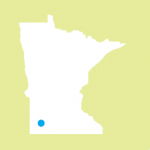 The largest lake in southwest Minnesota and the headwaters of the Des Moines River, Lake Shetek was the site of one of the most chronicled battles of the U.S.-Dakota War of 1862. A monument memorializing the settlers who were killed and one of their original cabins can be seen at Lake Shetek State Park. A land bridge provides access from there to the wooded Loon Island. Stay overnight in a tent, RV, or camper cabin at the park, or check in at Lake Shetek Resort on Valhalla Island.

Courtesy of Explore Minnesota
Lake Okabena
County: Nobles
Area: 776.05 acres
Maximum Depth: 16 feet
 Okabena means “home of the heron” in Sioux, but today the lake is best known as the home of windsurfing. If you missed the annual Worthington Windsurfing & Music Festival in June, there are still plenty of reasons to visit. Runners and bikers can circle the entire lake on the 5-mile Okabena Lake Trail, with nine city parks along the way and direct access to downtown Worthington. If you want to get out on the water, canoes, kayaks, and paddleboards can be rented from The Beach Nook at Centennial Park.
Lake Pepin
County: Goodhue
Area: 29,295 acres
Maximum Depth: 60 feet
 Lake Pepin extended all the way to what is now St. Paul when it was formed roughly 12,000 years ago. The 21-mile-long and nearly 2-mile-wide lake sits within the Mississippi River, and has provided centuries of utility, recreation, and inspiration to the many people who have lived along its banks—including Ralph Samuelson, who is credited with inventing waterskiing here in 1922. A $50 million restoration project is underway to counteract the sediment that continues to pile up, threatening to make parts of the lake disappear within 300 years if not addressed.

Courtesy of Explore Minnesota
Fairmont Chain of Lakes
Much like Minneapolis, the Fairmont Chain of Lakes consists of five lakes interconnected by channels. Boaters can navigate George, Sisseton, Budd, and Hall lakes without leaving the water; the fifth, Amber Lake, is separated by a dam. Bring your own boat or rent a pontoon from Hall Lake Cabins or a kayak at Gomsrud Park. Fishing piers are plentiful, and lakes are stocked with walleye, bluegill, and muskie, along with a dozen other species.
More Southern Lakes to Explore
- Albert Lea Lake
- Cannon Lake
- Eagle Lake
- Elysian Lake
- Heron Lake
- Lake Byllesby
- Lake Hanska
- Lake Jefferson
- Lake Washington
- Madison Lake
- Swan Lake