


Courtesy of Save the Boundary Waters
On April 16, the U.S. Senate has passed legislation that could significantly reshape the future of one of Minnesota’s most treasured natural landscapes. In a narrow 50-49 vote, lawmakers approved H.J. Resolution 140, a measure that would revoke a 20-year mining protection for more than 225,000 acres of federal land in the Boundary Waters watershed.
The original protection, enacted in 2023 under Public Land Order 7917, blocked mineral leasing in the headwaters of the Boundary Waters Canoe Area Wilderness and Voyageurs National Park. Its reversal opens the door for renewed exploration and potential sulfide-ore copper mining in the region—a long-debated issue with implications for both the environment and the economy.
In a joint statement, members of the Native American Caucus in the Minnesota Legislature called the vote “a dark day for our people and homelands,” emphasizing that the Boundary Waters watershed lies within Ojibwe-Dakota treaty territory and remains vital to cultural, spiritual, and subsistence practices. They warned that opening the area to sulfide-ore mining poses long-term risks to water quality, wildlife, and public health, noting that pollution in such an interconnected system would be irreversible. The group also raised concerns about impacts to Tribal sovereignty and future generations, urging state leaders to use their authority to protect the region and prevent further development.
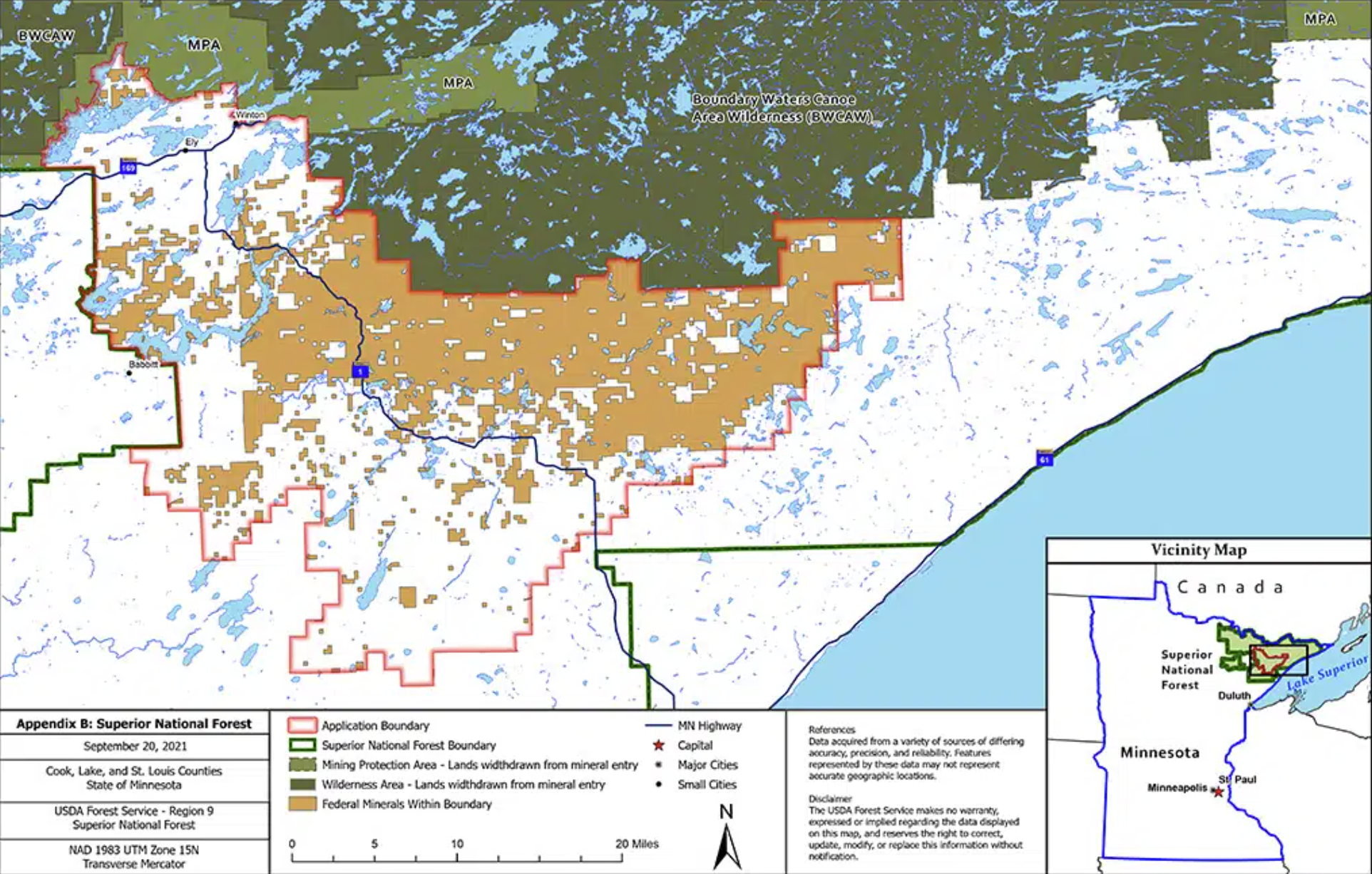
Map Courtesy Bureau of Land Management
Supporters of the resolution argue that lifting the ban allows for further study and responsible development of mineral resources. Opponents, however, point to the unique and fragile nature of the Boundary Waters ecosystem, where interconnected waterways mean that any contamination could spread quickly and have lasting impacts.
The vote does not immediately authorize mining. Projects would still be required to go through extensive federal and state environmental review and permitting processes, which can take years and ultimately determine whether development moves forward.
Still, the decision marks a major shift—and one that has drawn strong reaction across Minnesota and beyond.
“Today is a dark day for America’s most beloved Wilderness area, the Boundary Waters Canoe Area Wilderness, and a stark warning call for public lands nationwide,” said Ingrid Lyons, executive director of Save the Boundary Waters. “Minnesotans and the American public writ large have been loud and clear—this iconic place needs to be protected. Today, by the very people who claim to represent them, they were ignored. But it’s not over, and we will always keep fighting.”
With the resolution now expected to be signed into law, attention turns to what comes next—both in the regulatory process and in the broader conversation about how Minnesota balances conservation with economic opportunity in one of its most defining landscapes.

Photo by Benjamin Olson/Friends of the Boundary Waters
Why This Matters
What’s at stake in the Boundary Waters debate extends well beyond a single mining project. The region contains some of the cleanest freshwater in the country, with the Superior National Forest alone holding roughly 20% of all freshwater in the U.S. National Forest System. Hundreds of its lakes and rivers are designated “Outstanding Resource Value Waters,” meaning they are considered among the highest-quality waters in the state.
Ecologically, the Boundary Waters is one of the most biodiverse landscapes in the Midwest. It supports more than 316 bird species, including the highest diversity of breeding warblers on earth, and serves as critical habitat for federally threatened species like the Canada lynx, gray wolf, and northern long-eared bat. Nearly half of Minnesota’s native fish species are found within the Boundary Waters and Voyageurs National Park.
Opponents of sulfide-ore copper mining warn that the risks are significant and long-lasting. This type of mining is widely associated with pollution, producing waste that can generate sulfuric acid and release heavy metals such as mercury, arsenic, and lead—chemicals identified as major public health concerns. Because the region’s waterways are deeply interconnected and have low natural buffering capacity, even small amounts of contamination could spread widely and persist for generations.
There are also economic implications. More than 350 businesses are tied to the Boundary Waters recreation economy, and estimates suggest that protecting the region could generate more long-term jobs and income than mining development. Additionally, the area plays a role in climate resilience, with its boreal forests and wetlands acting as significant carbon sinks. Disturbing these systems could release stored carbon and reduce future sequestration capacity.
Taken together, the conversation centers on balancing potential resource development with the protection of a rare, interconnected ecosystem—one that supports wildlife, local economies, public health, and a globally significant freshwater resource.

Photo by Steve Piragis
How You Can Help
Following the Senate’s passage of H.J. Res. 140, supporters are being encouraged to take action at both the federal and state levels. Contact your elected officials—especially Minnesota legislators—to voice your support for protecting the Boundary Waters watershed. Staying informed is key, so consider signing up for action alerts to receive updates on advocacy efforts and opportunities to get involved.
You can also support the cause by donating to organizations working to defend the region, volunteering your time, or helping grow awareness by sharing information within your networks and on social media. Businesses can join coalition efforts to show unified support, while individuals can contribute in small but meaningful ways—every action helps build momentum to protect this landscape. You can also join the Earth Day rally at the Minnesota State Capitol on Wednesday, April 22, 2026, from 10-11 a.m., for a morning of speakers, community connection, and collective action centered on protecting Minnesota’s water, wilderness, and wild places.
Resources
- Boundary Waters Business Coalition
- Boundary Waters Connect
- Boundary Waters Defense Fund
- The Conservation Alliance
- Friends of the Boundary Waters
- Kids for the Boundary Waters
- Northeastern Minnesotans for Wilderness
- Save the Boundary Waters Action Fund
- Sportsmen for the Boundary Waters