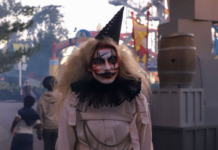


The Mantorville Opera House is haunted by at least four ghosts, and one of them is a cat. “Ellen is our main ghost,” says Annie Johnson, president of the Mantorville Theatre Co.‘s board of directors. “She’s known mostly for—what I like to call—playing pranks on us during production. The ghost cat likes to hang out up in the sound booth.” Story goes: Somebody found a mummified feline cemented behind a basement wall, Edgar Allan Poe-style, and the rest is history.

Photo by Andrew Stark
Hawk Horvath, founder of After Hours Paranormal Investigations, has spent 18 years conducting ghost hunts at the Opera House, and has “encountered the regular ghosts—including Ellen,” and others named Robert Sorenson and Harold. But Horvath reassures: “There is nothing negative or harmful there.”
And, since anybody who has studied paranormal thermodynamics knows the human body produces enough energy to power a light bulb, it should come as no surprise that something might linger in a place after death. Especially if that place is old, and the tiny town of Mantorville is older than Minnesota itself.
Mantorville sits northwest of Rochester, at the edge of the Driftless, where sprawling farm country starts to flex into bluffs and ravines. It’s named after Pennsylvanian brothers Peter and Riley Mantor, who settled there in 1854.
It feels more townlet than town, someplace William Wordsworth might have written about—an absurdly picturesque 1.5-square-mile crossroads bisected by the Zumbro River. The courthouse, along with some of the other structures in town, is big, old, and stately, and was constructed using limestone from Mantorville’s quarries. Antique shops make up most of the local commerce. There’s a covered bridge and so much preserved history the place feels vaguely museum-ish, à la Forestville. And besides a Casey’s gas station, nearly the entire village made the National Register of Historic Places, joining the likes of Williamsburg, Virginia, and Gettysburg, Pennsylvania.

Photo by Jalissa Tauscher/JRNY Photography
For its history alone, Mantorville is worth a visit—but there’s plenty to do and see during your stay. In fact, here’s a quick itinerary:
Wake up in your tent (or RV; there are no hotels in town) at Stussy RV Park. Grab an Americano and stuffed hash browns at County Seat Coffeehouse on Fifth Street and wander exactly 1,056 feet to Riverside Park to scope out the dam and snap a photo of the covered bridge, which leads to something called Goat Island—in the 1950s, the local dog catcher would ferry several goats to this island every spring to keep the weeds under control.
Riverside Park is also home to the Larger Than Life Outdoor Art Exhibit—the largest outdoor art exhibit in southern Minnesota. Brian and Mary Jo Hindal launched the Larger Than Life nonprofit in 2020 to offer a safe, outdoor art experience during the pandemic. What started with just four artists has since grown to feature 28 participants, with each artist’s chosen work displayed on 4-foot-by-8-foot panels throughout the park.

Courtesy of Brian Hindal
The annual exhibit is currently on display through Sept. 1, after which the art is removed from the park and reinstalled on the sides of local businesses in Mantorville and Dodge County for the community to enjoy for two years.
Afterward, peruse the stunning collection at Memorabilia Antiques, which is housed inside a former 1860s grocery and hardware store; a round of golf, if you’re so inclined, out at Zumbro Valley, followed by a round of drinks and “Hole in One-ion Rings” at Hidden Pines Bar & Grill; or catch a play at the Opera House. Finally, if you’ve worked up an appetite, it’s time for a world-class dinner at Mantorville’s crown jewel: The Hubbell House.

Courtesy of The Hubbell House
Things worth preserving are, hopefully, preserved. And, as mentioned, Mantorville feels a bit like a living museum—you might expect the bartender at Mantorville Saloon to sidle up in some petticoats stiffened with horsehair, but they probably won’t. This preservation is due to the work of the Mantorville Restoration Association (MRA), the Dodge County Historical Society, and the U.S. Department of the Interior. Together, they established Mantorville’s Historic District back in 1974, which includes 24 exceptionally maintained structures like Cooper’s Log House, the Normal School, and the Old Settler’s House—many of which are, of course, “said to be haunted.”

Photo by Jalissa Tauscher/JRNY Photography
“Every community has a story, none the same as another,” says Paul Larsen, vice president of the MRA and proprietor of Memorabilia Antiques. “It’s important to honor [the early settlers’] creativity, optimism, and hard work by sharing their stories, preserving the community heritage and, when possible, maintaining the sites and structures to the best of our ability so future generations can learn from them as well.”
In preserving history, we preserve our own stories, and the parts of ourselves that can neither be created nor destroyed—like the Opera House ghosts, that energy continues, however repurposed. In this way, we keep our light bulbs burning.