

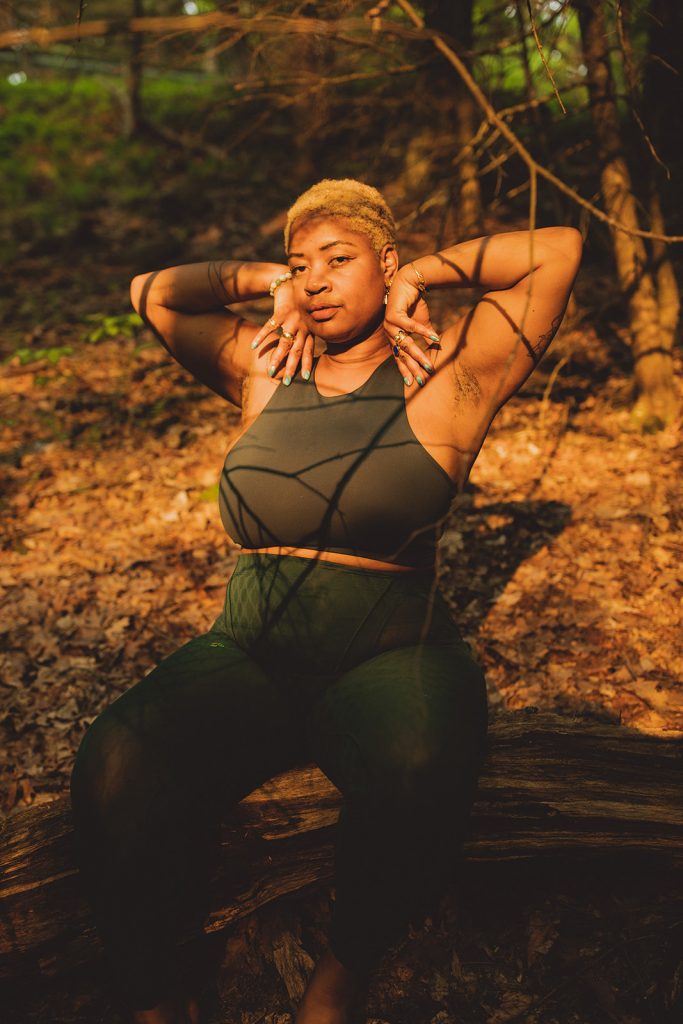
Photo by Thais Aquino
It’s a gray, rainy Friday at Bichota Coffee in Minneapolis, a slow afternoon with warm light and soft music. Two baristas light up when Junauda Petrus walks in, one telling her that “The Stars and the Blackness Between Them” had changed how she understood love. Petrus smiles, open and unguarded, her presence filling the quiet room, expressing her gratitude. Within minutes of meeting, it felt less like an interview and more like catching up with an old friend. Petrus is quick-witted and disarmingly open, joking that her curiosity fuels the art. “I’m nosy,” she tells me. “That’s what inspires my work, put that in the article.” And it makes sense. As Minneapolis’ Poet Laureate, Junauda Petrus is the city’s listener-in-chief: curious, observant, and intent on revealing the poetry that already exists all around us.
Born into a home alive with creativity—her Trinidadian mother expressing love through the kitchen, her St. Croix–born father filling the house with reggae—Petrus found language early. She remembers falling for words in kindergarten, when a classmate handed her a Valentine’s poem: “Roses are red, violets are blue…” It taught her metaphor, feeling, connection. Her father, who named her, told her she was her own definition: “When I say Junauda, I’m telling people I am me, and I’m not them.” It’s a mantra she still carries.
A multidisciplinary artist—dancer, playwright, fiction writer, aerialist, and the 2025-26 Poet Laureate of Minneapolis—Petrus sees the role as a rite of passage, especially following the recent passing of Nikki Giovanni. “I have to accept that I’m an artist and have something meaningful and necessary for this world,” she says. With that acceptance comes responsibility: “The main responsibility is to do it in my own integrity.” She hopes to write poetry that could only come from Minneapolis—poems born of its contradictions and care, its grief and grace—and, in doing so, to center those often left out of literary spaces: young people, elders, the working poor, houseless neighbors, and anyone who may not see themselves as poets at all.
“Poetry is really good at having conversations that are hard to have,” she tells me. “You get to feel before you think. We need to feel more, get comfortable with feeling. We need to think and process and also dream.” Her goal is to meet folks where they are, even if that means getting unconventional. “It’s a radical role and that calls for a radical approach,” she explains.
Petrus’ radicalism isn’t about politics so much as truth-telling and tenderness. “Every city, every place on the planet needs different ways to absorb and process and dream,” she says. “Poetry is one of those ways.” Her work is rooted in Minneapolis—its sounds, its people, its daily rhythms. Riding her bike or taking the bus, she observes the city from the ground up. “When you see more, you feel more,” she explains, noting how those everyday encounters fuel her work. “I want to do it in spaces like the bus, barber shops, in everyday life. Doing it out of buses because I rode buses—I’m a bus rider. And the bus is where some of my deepest inspiration comes from because it’s so many people sharing a confined space.”
When asked what she hopes to leave behind, her answer is bold, ambitious, and deeply human: “Ending the police state,” she says. “People spending more time in nature, away from jobs that suck us dry. I want us to feel more love, more safety, more nourishment, more slowing down. A legacy where we feel worthy of love and of expressing who we are.” It’s a manifesto for softness in a world that so often demands hardness—a call to be present, embodied, alive.
Before we part, I ask what advice she’d give young artists finding their way. Her response is immediate: “Whatever you feel, whatever’s in your imagination, put it on the page. Make it. Even if it’s just you and your homies in the living room. Don’t worry about where the art will go—it’ll go where it needs to. Just take pleasure in creating.” She pauses, then grins. “I have a pro-cringe agenda. We’ll always think something is cringe when it’s ours, because it hasn’t happened yet—but that’s where the magic lives. Imagine Toni Morrison thinking she was cringe.”