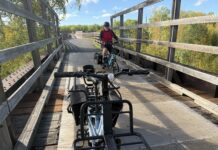


Courtesy of Move Minnesota
Last September, the U.S. Department of Transportation under President Donald Trump began revoking or canceling grants that had already been announced—grants that would help fund urban bike lanes, recreational trails, and more cycling and pedestrian infrastructure all around the country, including in Minnesota. Officials cited “hostility to motor vehicles” as the rationale behind the claw-backs, arguing that grant programs should focus on major roads and other projects that support car-focused travel.
Now, Minnesota cycling advocacy organizations are stepping up to raise awareness of the funding cuts and shine a spotlight on why bike-friendly infrastructure, from countryside trails to urban lanes, matters.
Erik Noonan is the communications manager at the Bicycle Alliance of Minnesota (BikeMN), a nonprofit that focuses on making Minnesota “a place where it is easy, convenient, and safe to bike, walk, and roll,” Noonan says. The organization provides a curriculum for elementary and middle schoolers on getting around without cars and engages with the state legislature and agencies to improve bike access. “Minnesota has always excelled at bike infrastructure and policy when compared to the rest of the nation,” Noonan says. But the bike outlook for the state is facing two key challenges.
First, funding for “the good stuff” is getting harder to find. “Corridor funding typically only extends to the car-prioritized roadway, and not the pieces of infrastructure that bike riders rely on,” Noonan says. Those pieces are, incidentally, also what make community spaces comfortable, beautiful, and enjoyable to spend time in. “No one wants to sit outside a coffee shop on a street that feels like a highway. No one wants to have a picnic in a parking lot.”
The second main challenge, according to Noonan, is the (false) idea that enough has been done to make cities bike friendly, especially in urban areas like Minneapolis, St. Paul, Duluth, and Rochester. Many municipalities—including the big ones listed here—are still making progress on decades’ worth of adopted plans to improve cycling and pedestrian infrastructure. Noonan mentions the Rochester Active Transportation Master Plan, the St. Paul Bicycle Plan, and many statewide Safe Routes to School initiatives as examples of in-progress work that are now threatened by funding cuts. “All of these deserve to be seen through, and compromising on quality will compromise on results,” Noonan says. “After all, a 90% safe route is not a safe route.”
“Overall, there’s plenty of community demand for more bikeways,” says MJ Carpio, executive director of Move Minnesota, an organization that advocates for better transportation options for Minnesotans—from bikeways to passenger rail and everything in between. On the side of optimism, Carpio notes that, as of this writing, 12 projects in the Metro area will be funded through 2029 under the Met Council’s Regional Solicitation process. “People have [also] been excited about the creation of the state’s first e-bike rebate program,” Carpio says.
“There’s rightfully pessimism, however, in how bikeways are designed and whose perspectives are included in the process,” she adds. A recent campaign in Minneapolis asks for dedicated bus lanes, protected bike lanes, and wider sidewalks. “Decision makers apply a double standard to people who bike and take public transit—they supposedly either just commute or just visit shops, but not both—whereas you can take your car to do anything,” Carpio says.
Looking ahead, Move Minnesota will work to clarify what “highway purposes” means for state and local agencies, so that existing funding can go to support infrastructure for all modes of transportation, including cycling—not just cars.
BikeMN’s advocacy work in 2026 will focus on helping to end the trend of car-only infrastructure spending; pushing for the use of the “Idaho Stop,” where cyclists can treat a stop sign as a yield sign; and making it clear that e-motos (not to be confused with e-bikes) aren’t legal on roads and trails in Minnesota.
“At a local level, we’re working on ensuring the adopted Summit Avenue Regional Trail plan doesn’t get derailed by a small group of wealthy opponents, and getting the fantastic Rochester bike system connected into their downtown with world-class infrastructure,” Noonan says.
BikeMN will also expand its advocacy this summer to communities located along state cycling trails. “These communities are often the economic engines of their regions, in no small part thanks to the two-wheeled culture they champion,” Noonan says. “We hope to help them maximize the infrastructure made possible by the advocacy work we have all benefitted from.”
To learn more and to get involved with local bike advocacy efforts, visit bikemn.org and movemn.org.